How major eruptions changed harvests, climate, and societies
Samalas, Laki, and Tambora disturbed the atmosphere. Season, circulation, food reserves, and institutions determined how far the damage reached.
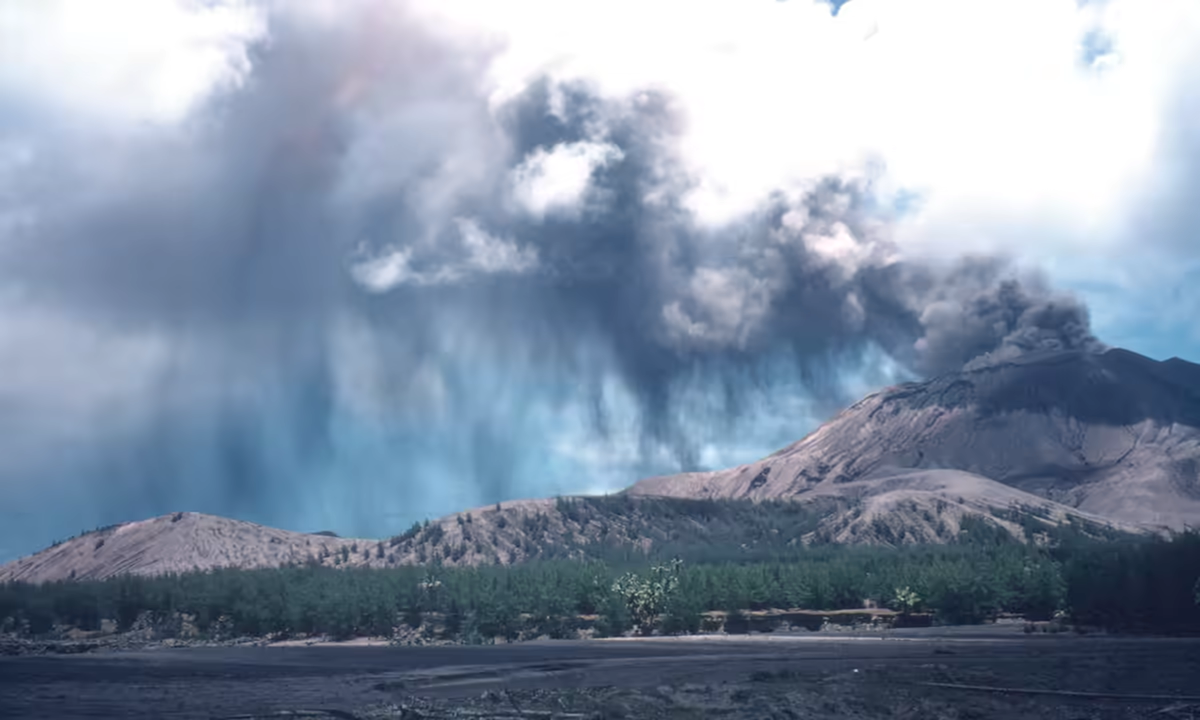
A 2024 study returned to Iceland's parish registers, hunger accounts, and reconstructed pollution after the 1783–1784 Laki eruption. The geography and timing of deaths fit hunger and disease better than a direct toxic cause. Access to fishing, household reserves, earlier bad weather, and delayed food aid help explain why districts exposed to the same disaster fared differently.⁶
Past eruptions follow the same chain. A volcano creates a measurable physical disturbance. Season and atmospheric circulation distribute it. Harvests translate temperature and rain into food, while markets, institutions, and ongoing crises determine who can absorb a shortage.
Samalas in 1257, Laki from June 1783, and Tambora in 1815 each moved through that chain differently. Their histories show why a sulfate peak in ice or a hemispheric temperature anomaly cannot, by itself, explain a famine, a death toll, or political change.
Sulfur carries an eruption into the climate system
The principal climate agent in a large explosive eruption is often sulfur dioxide that reaches the stratosphere. There it helps form sulfuric-acid droplets. These aerosols reflect incoming sunlight and can cool the surface for one to three years. The visible ash settles in days or weeks and usually plays a much smaller role in sustained global cooling.¹
The response still varies after a very large sulfur injection. A volcano's latitude, plume height, eruption month, and stratospheric winds shape the spread. Ocean state and circulation patterns then redistribute the signal. A colder hemispheric average can coexist with warmth in one region or with a winter pattern that departs from uniform surface cooling.
Agricultural timing supplies the next filter. Cold during dormancy differs from frost at flowering. Rain may rescue a dry field or prevent a harvest. Crop loss becomes a price shock where stocks are thin, transport is poor, or trade cannot replace supply.
Samalas intensified famines already underway
In 2013, researchers identified Samalas, part of the Rinjani volcanic complex on the Indonesian island of Lombok, as the source of the enormous 1257 sulfate layer. Deposits, dating, geographic distribution, and a local chronicle tied the caldera to an event long visible in ice cores.⁵ Later work placed the eruption among the largest stratospheric gas releases of the Common Era.⁴
Tree rings, ice cores, and historical documents indicate that 1258 and 1259 brought some of the coldest Northern Hemisphere summers of the past millennium. Cooling was uneven. Western Europe, Siberia, and Japan were hit hard, while Alaska and northern Canada were warmer than average. The researchers connect part of that contrast to Pacific circulation.³
Contemporary records describe severe famines in England and Japan. Their chronology rules out Samalas as the starting gun: both food crises had begun before the eruption. The study concludes that the climate shock aggravated existing crises.³ England was already dealing with poor harvests and political conflict. Japan's Shōga famine also preceded the clearest post-eruption cooling. Samalas added difficult seasons to societies that were already spending their safety margins.
Laki joined toxic exposure to a food-system collapse
Laki was a long fissure eruption, running from June 8, 1783, to February 7, 1784. Gas, acid rain, and fluorine-rich ash damaged Icelandic pastures and killed much of the livestock. That pathway into famine is well documented. By 1786, the population had fallen by nearly 20 percent through excess deaths and fewer births.⁶
The immediate cause of each death is harder to separate. Earlier studies attributed mortality in Iceland and Europe to the sulfur haze. Atmospheric reconstructions can also model historical fine-particle exposure and convert it into a potential mortality burden.⁷ Those calculations depend on reconstructed weather and modern exposure-risk relationships; they are not observed counts from 1783.
The 2024 reappraisal compared estimated pollution with when and where Icelanders died. The match was weak. Hunger and infectious disease better explained the pattern once the authors accounted for fishing, food reserves, Danish aid, and conditions before the eruption. Northeastern districts had already endured harsh winters and livestock losses. Coastal communities with fish and stored food survived the first winter more successfully; some deteriorated later after a poor hay harvest and depleted reserves.⁶
The pollution was real and hazardous. The surviving evidence does not establish it as the dominant direct cause of Icelandic mortality. The same restraint applies to distant weather anomalies: Laki may have shifted the odds of drought, heat, or cold, but attribution of a particular regional event remains probabilistic.⁶
Tambora struck during an already cold decade
Tambora erupted violently on Sumbawa in April 1815. The Smithsonian records the episode as VEI 7, the category for a colossal eruption, with its caldera-forming explosion on April 10.² Stratospheric aerosols reduced incoming radiation over the following years. An Earth-system review estimates annual cooling of roughly 0.4 to 0.8°C across the tropics and the extratropical Northern Hemisphere relative to the previous 30 years.⁸
The “Year Without a Summer” in 1816 brought abnormal cold and precipitation to parts of the Northern Hemisphere. In the Czech Lands, instruments and documentary evidence record an extremely wet summer in 1815, an extremely cold one in 1816, poor grain harvests, and widespread price increases in 1817.⁹ That sequence makes the route from aerosol to food visible, but it remains regional. Other places had different seasons, crops, and supply networks.
Tambora also arrived in a climate that had already cooled. An unidentified eruption in 1808 or 1809 had put sulfate into the stratosphere. Reduced solar activity during the Dalton Minimum may have contributed to the early-1810s trend. Model responses diverge with the initial oceanic and atmospheric state.⁸ Tambora was the largest known impulse in that sequence, without accounting for every cold year from 1810 through 1819.
What the scientific community is still resolving
Four questions keep attribution open. The stratospheric dose concerns how much emitted sulfur became aerosol and how long it remained aloft. Regional circulation asks why the same radiative forcing produced severe cooling in one area and little response in another.³ ⁴ ⁸
Cause of death requires separating gases and particles from hunger and disease, a difficult exercise with centuries-old evidence.⁶ ⁷ Capacity to respond follows stores, fishing, trade, and public relief, factors that changed outcomes within Iceland and among regions affected by Tambora.⁶ ⁹
Sources
- Volcanoes Can Affect Climate · U.S. Geological Survey · https://www.usgs.gov/programs/VHP/volcanoes-can-affect-climate
- Tambora · Smithsonian Global Volcanism Program · https://volcano.si.edu/volcano.cfm?vn=264040
Show 7 more sourcesHide sources
- Climate response to the Samalas volcanic eruption in 1257 revealed by proxy records · Nature Geoscience · https://www.nature.com/articles/ngeo2875 · 2017
- The 1257 Samalas eruption: the single greatest stratospheric gas release of the Common Era · Scientific Reports · https://www.nature.com/articles/srep34868 · 2016
- Source of the great A.D. 1257 mystery eruption unveiled, Samalas volcano, Rinjani Volcanic Complex, Indonesia · PNAS · https://doi.org/10.1073/pnas.1307520110 · 2013
- “More poison than words can describe”: what did people die of after the 1783 Laki eruption in Iceland? · Natural Hazards and Earth System Sciences · https://nhess.copernicus.org/articles/24/2971/2024/ · 2024
- Mortality induced by PM2.5 exposure following the 1783 Laki eruption using reconstructed meteorological fields · Scientific Reports / PMC · https://pmc.ncbi.nlm.nih.gov/articles/PMC6203706/ · 2018
- Tambora 1815 as a test case for high impact volcanic eruptions: Earth system effects · WIREs Climate Change · https://climate.envsci.rutgers.edu/pdf/RaibleTambora_wcc407.pdf · 2016
- Climatic effects and impacts of the 1815 eruption of Mount Tambora in the Czech Lands · Climate of the Past · https://cp.copernicus.org/articles/12/1361/2016/ · 2016
— Newsroom