The chemistry of preserving luminous art
Fluorescent pigments emit under illumination; phosphorescent ones retain an afterglow once the source is removed. Composition, light dose and humidity guide display and storage.
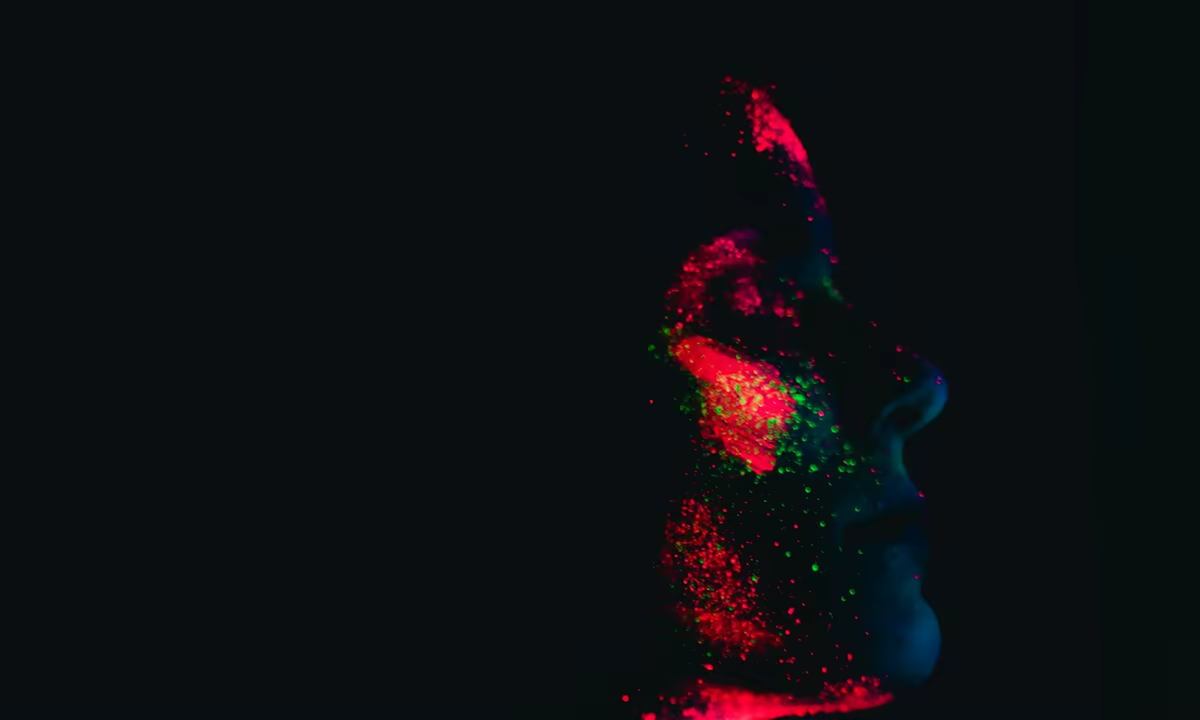
On 25 August, at ACS Fall 2026 in Chicago, photochemist Sarah Schmidtke Sobeck presented ongoing studies of the composition, spectral properties and stability of fluorescent and phosphorescent materials used in art.¹¹ An initial finding released by the American Chemical Society suggests that prolonged high humidity can damage some phosphorescent pigments as much as ambient light, and sometimes more.¹
The public abstract and ACS release describe photography used by undergraduate Eleanor Fleming to track the afterglow of samples containing lithopone. They provide no sample size, decay curves, humidity levels or test duration, and link to no scientific paper.¹ ¹¹ This is a preliminary conference result, insufficient to establish one environmental rule for every luminous paint.
The project extends a ten-year collaboration between Sobeck at the College of Wooster and Gregory Smith, a conservation scientist at the Indianapolis Museum of Art at Newfields. Their earlier work grew from the museum’s Stephen Sprouse collection. Sprouse was known for graffiti-covered Day-Glo fashion. His mother and brother donated more than 10,000 pieces to the museum, and an exhibition of the collection included clothes and shoes.² Colour and emitted light are part of these designs, while the chemicals that produce them change at different rates.
Fluorescence and phosphorescence work on different timescales
Both effects begin when a material absorbs energy. A fluorescent pigment emits visible light during excitation and goes dark almost immediately when the source is removed. Blacklight, rich in ultraviolet radiation, makes the paint appear to switch on as long as the lamp remains on. A phosphorescent material holds energy in longer-lived states and releases it gradually after excitation ends.³
The afterglow depends on composition. Luminous paints have used copper- or silver-activated zinc sulphide, while more recent products often contain doped strontium aluminate.⁴ When Smithsonian conservators studied a painting by Maceptaw Bogun, they timed an afterglow of more than two hours and combined that observation with X-ray fluorescence. The result indicated strontium aluminate, associated with hours of emission in their comparison, rather than zinc sulphide, associated with minutes.⁵
That identification affects treatment and display. Two surfaces that look green under gallery lighting may require different charging periods and emit differently in darkness.
The light that reveals the work changes it
In the daylight fluorescent artists’ pigments studied by Sobeck’s team, dyes and optical brighteners were embedded in a formaldehyde-rich polymer resin. Chromatography and spectroscopy showed that formulations vary between manufacturers and have changed over time.⁶ “Day-Glo” identifies a visual family, not a single chemical recipe.
In the Sobeck team’s earlier work, optical brighteners degraded faster than some pigment dyes. The surface lost luminosity and appeared darker even while dye molecules remained.¹ Separate experiments on nine fluorescent colourants recorded fading and shifts in colour after exposure.⁷
Museums manage that change as a dose. For sensitive materials, light damage is cumulative and irreversible; dose combines illuminance in lux with exposure time. The Canadian Conservation Institute gives a direct equivalence: 200 hours at 200 lux produces the same light dose as 400 hours at 100 lux. Ultraviolet filters reduce one part of the hazard, but visible light also drives photochemical damage.⁸
A work intended for blacklight requires controlled exposure. Dark storage removes the dose from display lighting while withholding the artist’s intended effect. Ultraviolet display restores that experience for visitors while accelerating fading and polymer degradation.⁶ Museums therefore need to limit accumulated dose without removing the illumination the work requires.
Microfading measures sensitivity to light
A single lighting rule cannot describe all modern pigments. A microfadeometer measures the object itself: a filtered source illuminates a spot about 3 millimetres wide while the instrument calculates changes in the CIELAB colour space. In the Smithsonian system, testing stops before ΔE 2, below the approximate ΔE 2.3 change considered just noticeable to an unaided viewer.⁹
The test applies a small, controlled dose to classify the surface’s relative sensitivity. A conservator can use the result to shorten an exhibition, lower the intensity, rotate objects or activate a lamp only when visitors are present. The test informs a display programme but does not predict an exact service life for the work.⁹
Humidity, temperature and physical condition remain part of the assessment. The preliminary ACS finding suggests that certain phosphorescent materials may also degrade in a dark, damp store.¹ A painted garment contains leather, cloth, adhesives and layered coatings that can crack or separate before its colour disappears.
A fluorescent repair needs two colour matches
A silver leather jacket designed by Sprouse carried a fluorescent Mona Lisa painted by Stefano Castronovo. Its full effect appeared under blacklight, while the paint itself had developed lifting, cracks and losses. In a conservation treatment published in 2019, the team stabilised the surface and filled missing areas so that the repairs worked under both visible and ultraviolet illumination.¹⁰
An inpainting colour that matches in daylight can emit too much, too little or at a different wavelength when the room darkens. The original continues to age after treatment, and the new material may change at another rate.
For similar works, composition, optical response and accumulated dose need to be part of the display plan. Those measurements help preserve original material while controlling how long the luminous effect is shown.⁸ ⁹ ¹⁰
Sources
- The hidden chemistry behind glow-in-the-dark art (ACS Fall 2026 findings, lithopone, humidity and optical-brightener degradation) · American Chemical Society · https://www.acs.org/pressroom/presspacs/2026/august/hidden-chemistry-behind-glow-in-the-dark-art.html · 25 Aug. 2026.
- Stephen Sprouse: Rock | Art | Fashion (collection, size of the donation and Day-Glo designs) · Indianapolis Museum of Art at Newfields · https://discovernewfields.org/events-exhibitions/stephen-sprouse-rock-art-fashion · accessed 25 Aug. 2026.
Show 9 more sourcesHide sources
- Fluorescence and Phosphorescence (definitions of emission during irradiation and long-lived emission) · IUPAC Compendium of Chemical Terminology · https://goldbook.iupac.org/terms/view/F02453 · https://goldbook.iupac.org/terms/view/P04569 · 2025 online edition · DOIs: 10.1351/goldbook.F02453; 10.1351/goldbook.P04569.
- Comelli, D. et al. Time-Resolved Photoluminescence Spectroscopy and Imaging: New Approaches to the Analysis of Cultural Heritage and Its Degradation · Sensors 14(4) · https://www.mdpi.com/1424-8220/14/4/6338 · 2014 · DOI: 10.3390/s140406338.
- Lunder Conservation Center: A Conservator Finds Art in the Dark (strontium aluminate identification and afterglow measurement) · Smithsonian American Art Museum · https://americanart.si.edu/blog/eye-level/2015/01/382/lunder-conservation-center-conservator-finds-art-dark · 1 Dec. 2015.
- Schmidtke Sobeck, S. J.; Chen, V. J.; Smith, G. D. Shedding Light on Daylight Fluorescent Artists’ Pigments, Part 1: Composition · Journal of the American Institute for Conservation 61(4) · https://www.tandfonline.com/doi/abs/10.1080/01971360.2021.1927653 · 2022 (online 2021) · DOI: 10.1080/01971360.2021.1927653.
- Beckett, F.; Shugar, A. Following the Light: Use of Multimodal Imaging and Fiber Optic Spectroscopy to Evaluate Aging in Daylight Fluorescent Artists’ Pigments · Colorants 1(2) · https://www.mdpi.com/2079-6447/1/2/13 · 2022 · DOI: 10.3390/colorants1020013.
- Light, ultraviolet and infrared (dose, irreversibility and the limits of UV filtering) · Canadian Conservation Institute · https://www.canada.ca/en/conservation-institute/services/agents-deterioration/light.html · updated 2017.
- Microfadeometer (illuminated area and ΔE threshold) · Smithsonian Museum Conservation Institute · https://mci.si.edu/microfadeometer · accessed 25 Aug. 2026.
- Beckett, F.; Holden, A.; Smith, G. D. Seeing the Light: Research, Conservation and Exhibition of a 1980s Daylight Fluorescent Painted Leather Jacket Designed by Sprouse and Painted by Castronovo · Journal of the American Institute for Conservation 58(4) · https://www.tandfonline.com/doi/abs/10.1080/01971360.2019.1614290 · 2019 · DOI: 10.1080/01971360.2019.1614290.
- Glow in the light & dark: Investigations of the photochemistry of emissive pigments used in art (programme and abstract for Sobeck’s ACS Fall 2026 presentation) · American Chemical Society · https://acs.digitellinc.com/live/37/session/595033 · 25 Aug. 2026.