Microsoft expands the bridge between Godot and Xbox
The add-on can now run inside engine forks built for Xbox Series X|S. The console port and export template remain outside the repository.
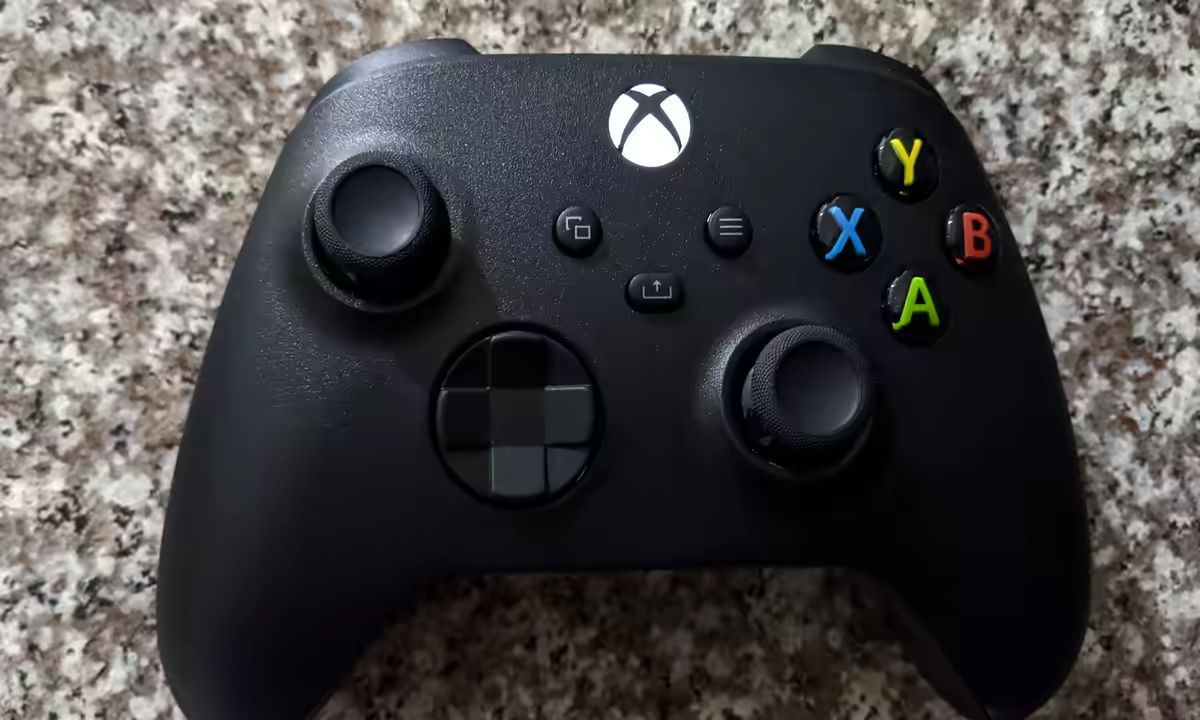
Microsoft released version 0.3.0 of XBOX-Godot-Sample on August 20, a reference repository containing add-ons that connect Godot projects to the Xbox ecosystem. The update lets the same godot_gdk add-on binary load inside engine forks built for Xbox Series X|S. It does not include a Godot console port or the export template required to turn a project into a game that runs on the hardware.¹
A studio that already has access to a compatible fork can reuse the integration layer for sign-in, achievements, storage, multiplayer, and other services in the Microsoft Game Development Kit, or GDK. The fork still has to provide the console platform layer and export path.
In June, Microsoft presented the public repository as an Xbox on PC reference and said it had no specific Xbox Series X|S or Xbox One support.² Version 0.3.0 makes room for the extension inside tools capable of reaching Series X|S. The official Godot editor still has no Xbox export target.
A naming collision blocked the two layers
Godot extensions register classes in one flat namespace called ClassDB. Console-capable forks already exposed types with a GDK prefix, which the Microsoft add-on also used. Two implementations could not register the same name in one project, so the conflict arose before the integration could be used.³
The fix renames every script-visible class from GDK* to Xbox*. The changelog counts 46 classes plus the abstract root. GDKUser, for example, becomes XboxUser. On the C# side, the GodotGdk namespace moved to GodotXbox, and the static Gdk class became Xbox.³ ⁴
Code that declared the old types faces a breaking change. Microsoft did not retain transitional aliases, so projects moving to the release must update those references. The migration guide says the rename itself changes no runtime behavior.⁴
One exception limits the size of that migration. The global singleton used by GDScript is still named GDK. Calls such as GDK.initialize() and access to its services remain intact, while the class behind that object now identifies itself as Xbox. References to the Microsoft GDK product and related project settings keep their existing names.⁴
“One binary” refers to the add-on
The release describes one add-on binary for PC and console. This part of the project does not need a second console compilation, console-only preset, or conditional flag. A compatible fork loads the same Windows libraries declared in godot_gdk.gdextension.¹ ⁴
The repository contains neither the engine changes that communicate with Series X|S hardware nor the templates that package an executable for the platform. Microsoft’s release assigns those responsibilities to the console-capable forks.¹
In the repository, godot_gdk wraps GDK APIs for GDScript and C#. Separate add-ons cover PlayFab and GameInput. The sample provides scenes and reference flows for common functions in a connected game. An engine port resolves a different set of dependencies around the target platform, compilation, and packaging.
The current README estimates that the project covers roughly 85% to 95% of the functional surface needed to ship on Xbox on PC.⁵ That is Microsoft’s own estimate of useful PC-facing services in the current release. It is not a measurement of console readiness and does not stand in for testing, certification, or platform-specific requirements.
The sample remains reference code
Microsoft’s original announcement defines XBOX-Godot-Sample as a source-only reference, assigns it no product status, and promises no fixed update or support cadence.² Its MIT license applies to the wrapper and sample. It does not cover the GDK, PlayFab, or other dependencies, which require separate installation and acceptance of their own license terms.² ⁵
This split lets developers study and adapt Microsoft’s bridge without opening the platform’s closed components. Version 0.3.0 did not make the GDK open source. It also left intact the commercial and technical conditions around Xbox publishing.
Godot’s console documentation lists the external steps that remain: registration as a developer with the console maker, approval, nondisclosure agreements, access to the SDK and tools, development hardware, and suitable export templates. The Godot Foundation does not distribute official ports for closed consoles. Approved studios can build their own templates or license a solution from an authorized provider.⁶
Sources
- v0.3.0 - Compatibility + Community Fixes · Microsoft / GitHub · https://github.com/microsoft/XBOX-Godot-Sample/releases/tag/v0.3.0 · Aug. 20, 2026
- Building XBOX Games with Godot: A New Sample to Get You Started Faster · Microsoft Game Dev · https://developer.microsoft.com/en-us/games/articles/2026/06/building-xbox-games-with-godot/ · June 4, 2026
Show 4 more sourcesHide sources
- CHANGELOG.md at v0.3.0 · Microsoft / GitHub · https://github.com/microsoft/XBOX-Godot-Sample/blob/v0.3.0/CHANGELOG.md · Aug. 20, 2026
- Migrating to v0.3.0 — GDK types are now Xbox types · Microsoft / GitHub · https://github.com/microsoft/XBOX-Godot-Sample/blob/v0.3.0/docs/gdk/migration-v0.3.md · Aug. 20, 2026
- XBOX-Godot-Sample · Microsoft / GitHub · https://github.com/microsoft/XBOX-Godot-Sample · accessed Aug. 26, 2026
- Console support in Godot · Godot Engine documentation · https://docs.godotengine.org/en/4.5/tutorials/platform/consoles.html · accessed Aug. 26, 2026