Tiangong runs 100 metres autonomously in 8.86 seconds
The humanoid completed an autonomous semifinal and hit a barrier beyond the line. The race measures bipedal speed with a standing start and a torso-defined finish.
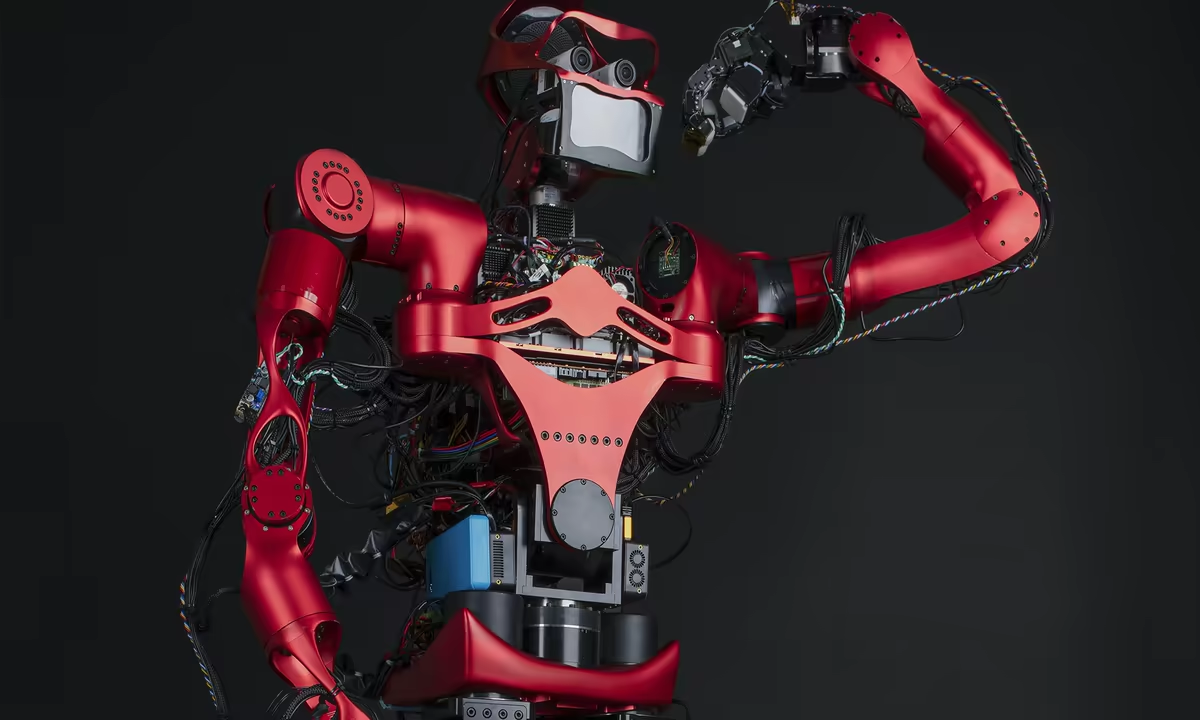
On 25 August, Tiangong Ultra covered 100 metres in 8.86 seconds during a large-size robot semifinal at the second World Humanoid Robot Games in Beijing. It crossed the line, struck the padded barrier, fell and sent sparks from its waist.¹ ² The result cut 0.53 seconds from the same model’s 9.39-second run at the opening.² Later that night, the Tianxiao team completed another heat in 8.85 seconds and advanced to the final with the fastest semifinal mark.¹⁶
The Games rulebook defines an autonomous race from a standing start. The robot must remain still behind the line until the gun, and timing ends when part of its torso reaches the back edge of the finish line.¹³ The document gives the track dimensions but does not identify the timing equipment or provide a survey certificate for the course.
The 8.86-second mark is 0.72 seconds faster than Usain Bolt’s human record. In the 2009 World Championships final, Bolt left starting blocks, reacted to the gun in 0.146 seconds, ran with a +0.9 m/s wind and received an official time of 9.58 seconds.³ World Athletics requires blocks linked to a certified Start Information System and fully automatic timing for a human world record; its outdoor sprint rules also govern wind.¹⁴ The marks come from different categories and rulebooks. Tiangong’s time is a benchmark for high-speed bipedal locomotion and does not alter the World Athletics record.
A sprinter built for the track
A running humanoid must create a flight phase, with both feet off the ground, and control its body on the next landing. Sensors track position and rotation; the controller selects the next foothold; motors and transmissions deliver force before a correction arrives too late. Impacts and the cost of each wobble rise with speed.⁴
The Beijing Humanoid Robot Innovation Center said the Tiangong used in the race received upgraded joints, a lighter frame and a more streamlined design. Ultra was designed for athletics, including races from 100 to 1,500 metres, relays and jumps.² That specialisation concentrates hardware and software on a narrow family of movements, without requiring the hand dexterity or navigation of a service robot.
The 2026 edition raised the control requirement. In 2025, the general rules admitted remote or autonomous operation.⁵ This year, the 100 metres required fully autonomous operation, with no person correcting each step.⁶ ¹³
In 2025, Tiangong won with an official result of 21.50 seconds after its raw time received a 0.8 coefficient for autonomy; two teleoperated robots had crossed first in 22.08 and 24.53 seconds.¹⁵ At the 2026 opening, Tiangong ran 9.39 seconds on the track under the new fully autonomous requirement.⁷ The change indicates a much faster race, but it is not a clean experimental series: both the rules and the platform changed between editions.
Braking sat outside the stopwatch
In 2022, Oregon State University’s biped Cassie ran 100 metres in 24.73 seconds for a Guinness record. Its protocol required a stationary start behind the line, the sprint, deceleration and a stationary upright finish without falling.⁸
The team’s technical paper divides the attempt into five stages and assigns two of them to entering and leaving the sprint. The speed controller could not stand still; researchers had to switch at the right moment between one neural network for running and another for posture.⁹ Cassie’s protocol included skills that Beijing’s padded finish omitted, so the gap between the two times does not measure speed alone.
Tiangong’s result rewards acceleration, balance and trajectory until the line. Because the rules end the measurement when the torso crosses, braking beyond the line is outside the official time.¹³ Dennis Hong, a UCLA robotics professor interviewed by the Associated Press, connected the fall to capabilities needed away from a track, including safe stopping, obstacle perception and recovery from an error.¹
Scenario contests measure integration
The Games announced 51 events and 1,301 sessions over five days. Twenty-one were scenario contests in which robots folded clothes, organised books, assembled parts, serviced a hotel or responded to emergencies. Some took place in factories, model homes and a hotel.⁶ ¹⁰
The rulebook calculates scenario-event scores from task points, penalties and the control mode. In some sequential tasks, an unfinished stage earns zero, and a referee may require the team to complete it before moving on.¹¹
In the hotel challenge described by Xinhua, more than ten teams had 30 minutes to move luggage of different sizes, replenish room supplies and make a bed. Autonomous operation received a coefficient of 1; teleoperation, 0.5.¹² The ranking combined physical skill and degree of autonomy in a single score.
“Autonomous” changes meaning with the task. The track is straight, known and isolated. In a room, the robot must recognise varied objects, navigate around furniture and finish a sequence. Even there, teams know the site and work to defined criteria. Everyday use adds people and objects outside the specification.
Visible failures produce useful data
The sports format supplies repetition and a legible metric. Different teams face the same track on the same day while motors and controllers operate near their limits. Cameras preserve falls and interventions that a commercial demonstration could edit out.
In scenario events, the most useful evidence comes from integration. Folding cloth combines perception of a deformable material, selection of grasp points and two-handed control. Making a bed adds navigation and planning over a longer sequence. Those capabilities are closer to commercial use than top speed, although the environment remains prepared.
A 2023 review of human and robot performance found that powerful specialised solutions have yet to be integrated into one system approaching human dexterity and versatility.⁴ The Games expose that division: the sprinter and the luggage handler share a category while solving different problems.
The same discipline applies when assessing surgical robots training inside virtual bodies: completion of a defined task supports a claim about that task. Tiangong’s evidence supports a high-speed mark in an autonomous straight-line race. Controlled stopping, fall recovery and work in unpredictable settings require separate tests.
Sources
- A Chinese humanoid robot sets a new 100-meter sprint record at Beijing Games (8.86 seconds, fall, sparks and Dennis Hong’s comments) · Associated Press · https://apnews.com/article/chinese-humanoid-robot-beijing-world-games-record-069b76ee6748154fd67bec39fa927cf6 · 25 Aug. 2026.
- Chinese humanoid robot Tiangong breaks 100m record again with 8.86-second sprint (semifinal, Tiangong’s specialisation and hardware changes) · Global Times · https://www.globaltimes.cn/page/202608/1368995.shtml · 25 Aug. 2026.
Show 14 more sourcesHide sources
- Official result for the men’s 100 m final at the 2009 World Championships in Berlin (9.58 seconds, +0.9 m/s wind, 0.146-second reaction) · World Athletics · https://worldathletics.org/results/world-athletics-championships/2009/12th-iaaf-world-championships-in-athletics-6998524/men/100-metres/final/result · 16 Aug. 2009.
- Riener, R.; Rabezzana, L.; Zimmermann, Y. Do robots outperform humans in human-centered domains? · Frontiers in Robotics and AI · https://www.frontiersin.org/journals/robotics-and-ai/articles/10.3389/frobt.2023.1223946/full · 2023 · DOI: 10.3389/frobt.2023.1223946.
- World Humanoid Robot Games Are Coming! (2025 rules allowing remote or autonomous control) · Beijing Municipal Government · https://english.beijing.gov.cn/latest/news/202505/t20250509_4085788.html · 9 May 2025.
- 2nd World Humanoid Robot Games to Run in Beijing in August! (fully autonomous 100 metres; scenario tasks and venues) · Beijing Municipal Government · https://english.beijing.gov.cn/latest/news/202606/t20260602_4682369.html · 2 June 2026.
- 第二届世界人形机器人运动会在京开幕 (9.39 seconds in 2026, 21.50 seconds in 2025 and remote control removed from several events) · Beijing Municipal Government / Beijing Daily · https://www.beijing.gov.cn/ywdt/gzdt/202608/t20260823_4833187.html · 23 Aug. 2026.
- Fastest 100 m by a bipedal robot (stationary start and finish; Cassie’s 24.73 seconds) · Guinness World Records · https://www.guinnessworldrecords.com/world-records/629600-fastest-100-m-by-a-bipedal-robot · accessed 25 Aug. 2026.
- Crowley, D. et al. Optimizing Bipedal Locomotion for the 100m Dash With Comparison to Human Running · arXiv:2508.03070 · https://arxiv.org/abs/2508.03070 · 5 Aug. 2025.
- 2nd World Humanoid Robot Games: Highlights & Ticket Info (dates, 51 events, 1,301 sessions and 21 scenario contests) · Beijing Municipal Government · https://english.beijing.gov.cn/latest/news/202608/t20260815_4824032.html · 15 Aug. 2026.
- 第二届世界人形机器人运动会比赛规则(第二批赛项) (task sequence and scoring formula in scenario events) · World Humanoid Robot Games Organising Committee · https://www.whrgoc.com/resources/uploads/20260616/1781569251143063157.pdf · June 2026.
- Humanoid robot games put real-world skills to the test (hotel challenge and autonomy/teleoperation coefficients) · Xinhua, republished by Guangming Online · https://en.gmw.cn/2026-08/25/content_38963065.htm · 23 Aug. 2026.
- 第二届世界人形机器人运动会竞技赛比赛规则 (100-metre categories, fully autonomous control, track, standing start and torso-defined finish) · World Humanoid Robot Games Organising Committee · https://www.whrgoc.com/resources/uploads/20260421/1776757128600097573.pdf · April 2026.
- Competition Rules & Technical Rules (ratification requirements for starting blocks, Start Information System, automatic timing and wind measurement) · World Athletics · https://worldathletics.org/download/download?filename=9b6dd391-ea84-4bc5-b7d1-4cec3587cb05.pdf&urlslug=C1.1+%26+C2.1+-+Competition+Rules+%26+Technical+Rules · rules in force, accessed 25 Aug. 2026.
- 全球首次!26个机器人世界冠军诞生 (raw times in the 2025 final and the 0.8 coefficient applied to autonomous Tiangong) · CCTV · https://news.cctv.com/2025/08/18/ARTIsvbOhXzQbxG9j2m6VmSA250818.shtml · 18 Aug. 2025.
- 4支赛队跑进9秒!人形机器人百米大型组复赛现场太激烈 (Tianxiao team’s 8.85 seconds and the semifinal qualification) · Beijing Daily · https://xinwen.bjd.com.cn/content/s6a8d9277e4b0e45f3fd67d51.html · 25 Aug. 2026.