Pixel Watch estimates metabolic trends without measuring glucose
The feature summarizes weeks of watch signals. It is a wellness tool, with no diagnosis, diabetes screening, or real-time glucose reading.
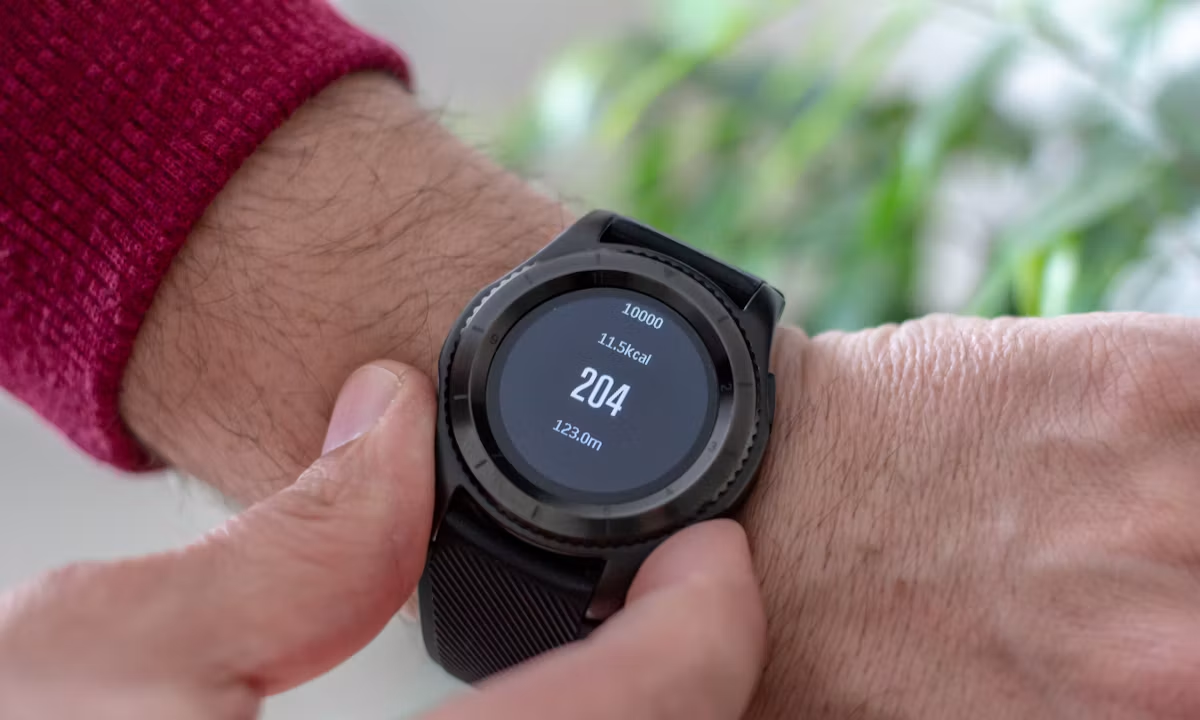
In August 2026, Google announced a feature for September that turns several weeks of Pixel Watch and Fitbit signals into a monthly summary called Insulin Resistance Trends. Everyday use requires no blood draw. The watch does not measure glucose, and its result does not tell a wearer whether they have insulin resistance.¹
Google classifies the feature as general wellness. Its published exclusions cover diabetes prescreening, continuous glucose monitoring, and decisions about medication or insulin. It is not intended for pregnant people.¹ The product is designed to display a persistent change in a metabolic pattern, a narrower role than its name might initially suggest.
As of August 26, Google's documentation named Pixel Watch 3, 4, and 5 and Fitbit Air, without publishing a complete country list or confirming availability in Brazil. The company says access varies by device, country, and region.¹ ⁵
The watch builds a history rather than a glucose sample
Google's product page names heart rhythm, sleep quality, and daily movement among the signals being followed. The model looks for relationships that persist over several weeks and presents one trend each month.¹ ⁵ That cadence is far removed from a sensor showing glucose around a meal or workout.
All of those inputs are indirect. Sleep, activity, and cardiovascular responses can be associated with metabolism, but none contains an insulin or glucose reading. The model's value rests on patterns learned from large datasets and on whether those patterns continue to hold in new wearers.
Another recent watch feature illustrates the difference in purpose. Breathing Emergency Detection looks for an acute event and may start an emergency call in supported countries. Insulin Resistance Trends summarizes a multi-week trajectory and stays within the general-wellness category.¹
Blood tests created the study reference
The main evidence comes from WEAR-ME, a Google-funded study published in Nature in March 2026. Researchers remotely enrolled 4,416 adults in the United States. The primary analysis retained 1,165 participants whose data were complete and met quality requirements. Their median age was 45, and median BMI was 28.²
Participants wore seven smartwatch models and four trackers, all made by Google or Fitbit, and completed fasting blood tests. The reference target was HOMA-IR, calculated from fasting insulin and glucose. Values of 2.9 or higher defined insulin resistance, values below 1.5 defined insulin sensitivity, and the middle range represented impaired sensitivity.²
HOMA-IR made a study of more than a thousand people practical, while remaining a proxy. WEAR-ME did not compare watch signals against the hyperinsulinemic euglycemic clamp, a more direct and much more involved laboratory procedure. Calling HOMA-IR the study's ground truth describes the experimental label; the wrist device itself never calculated it from blood.²
The main model combined wearable representations, demographics, and routine blood biomarkers. It reached an AUROC of 0.80, 76% sensitivity, and 84% specificity in binary insulin-resistance classification at the HOMA-IR threshold of 2.9.² Because that result includes blood-derived information, it does not describe the needle-free commercial experience.
Validation without biomarkers in the model was small
An independent cohort of 72 people tested what wearables added outside the main sample. Blood tests were still required to establish the reference HOMA-IR. In the configuration that did not receive routine blood biomarkers as predictors, watch representations plus demographics achieved an AUROC of 0.75. Demographics alone reached 0.66.²
Adding fasting glucose and a lipid panel raised AUROC to 0.88 when watch signals were included, versus 0.76 without them.² The higher figure still depended on blood tests. The 0.75 configuration comes closest to the product's premise without using blood as a model input, within a classification experiment involving 72 participants.
AUROC measures how well a model ranks positive cases above negative ones as the decision threshold changes. It is not the percentage of correct notifications an individual wearer should expect. Prevalence, threshold selection, and calibration in the intended population all affect false alerts and missed cases. Google has not published sensitivity or specificity for the commercial feature.¹ ²
Two foundation models sit behind the story
The Nature paper evaluated a wearable foundation model, or WFM, pretrained on 40 million hours of sensor data.² After that study, Google Research introduced SensorFM, pretrained on more than one trillion minutes of sensor signals from five million consenting participants.³ ⁴
SensorFM ingested 34 minute-level aggregate features derived from sensors including PPG and accelerometry. Its dataset covered September 2024 through September 2025, more than 100 countries, and over 20 Fitbit and Pixel device models.³ ⁴ Google says Insulin Resistance Trends uses its latest model and presents the Nature paper as scientific validation for the broader approach.¹
WEAR-ME's performance figures belong to the earlier WFM. SensorFM's much larger pretraining set does not automatically transfer an AUROC of 0.75 or 0.80 to the finished feature. Scale alone also cannot establish equal performance across countries, ages, or devices. The Nature study used Google/Fitbit hardware exclusively and was funded by Google; 12 authors were Alphabet employees who might own stock as part of their compensation, and two were Google interns.²
The regulatory boundary matches the announced function
Google describes Insulin Resistance Trends as wellness information: a monthly summary for following changes over time. The company explicitly excludes diagnosis, treatment, and diabetes prescreening. Insulin dosing and other medication decisions are outside its intended use.¹ ⁵
That boundary matches the available evidence. An observational study found that wearable signals improved separation between groups defined by HOMA-IR. The final feature still lacks public performance metrics and independent validation, in a larger cohort, of its final configuration without blood biomarkers as predictors.
Google's August 26 documentation said the feature was “coming September 2026,” without guaranteeing a specific day.¹ The documented launch promise is a monthly trend display. Any clinical conclusion will continue to require appropriate evaluation and tests that the watch does not perform.
Sources
- Track subtle changes in your body with Health Guardian features on Pixel and Fitbit · Google · https://blog.google/products-and-platforms/products/google-health/pixel-watch-health-guardian/ · Aug. 12, 2026
- Insulin resistance prediction from wearables and routine blood biomarkers · Nature · https://www.nature.com/articles/s41586-026-10179-2 · Mar. 16, 2026
Show 3 more sourcesHide sources
- SensorFM: Towards a general intelligence and interface for wearable health data · Google Research · https://research.google/blog/sensorfm-towards-a-general-intelligence-and-interface-for-wearable-health-data/ · Jul. 9, 2026
- Towards a General Intelligence and Interface for Wearable Health Data · arXiv · https://arxiv.org/abs/2605.22759 · rev. Jul. 16, 2026
- Is Your Body Managing Energy Efficiently? Your Device Can Now Tell You with Insulin Resistance Trends · Google Health · https://healthapp.google/latest-news/insulin-resistance/ · accessed Aug. 26, 2026