Meta Glasses make surveillance look like fashion
The new $299 line has real utility, better design, and a serious price. The problem is the social bargain: buyers get a camera on their face; everyone nearby becomes part of the interface.
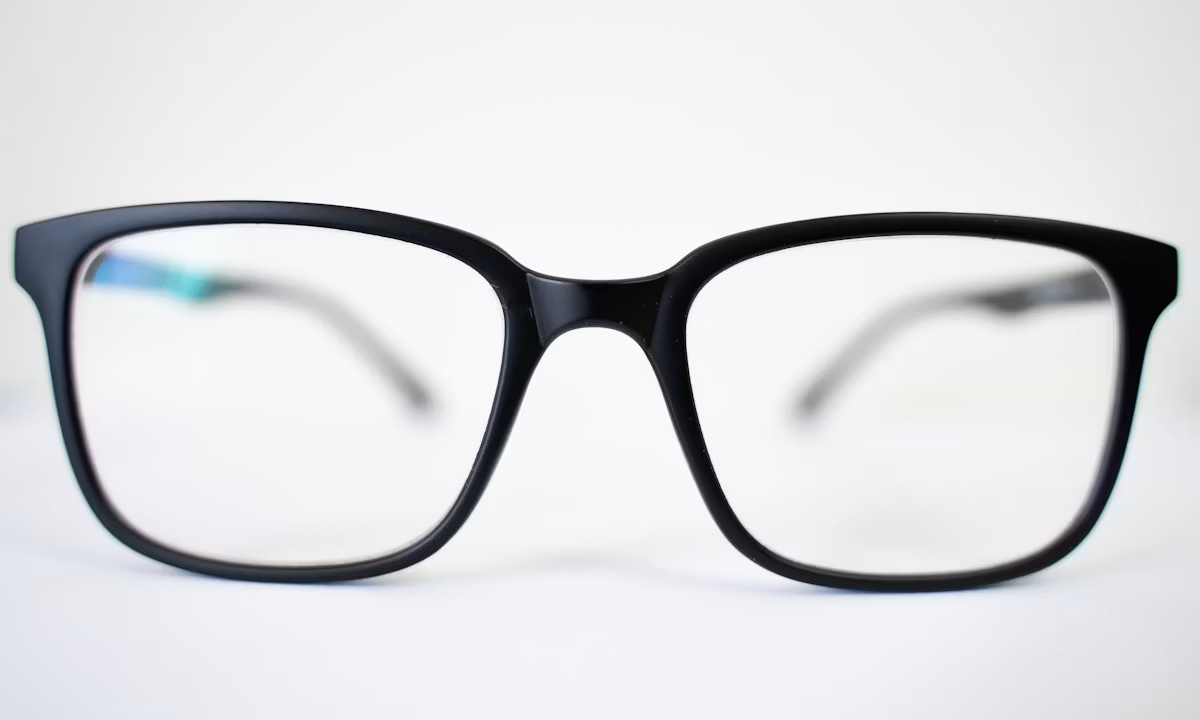
Meta got one hard thing right. The new Meta Glasses, built with EssilorLuxottica and announced on June 23, start at $299, support prescription lenses, ship in 26 frame-and-lens combinations, promise more than eight hours of battery life, and bring Muse Spark-powered Meta AI to your face from day one.¹ They don't look like a lab prototype. They look like glasses someone might actually buy.
That's the most important part, and the most uncomfortable one. The problem with smart glasses was never only technology. It was normality. Google Glass failed partly because it looked like a walking warning that you were being observed. Meta learned the opposite lesson: if the camera fits into acceptable frames, if open-ear audio works, if the assistant answers, if the price falls, social resistance falls with it.
The buyer gets convenience. Everyone nearby gets a new question: did I consent to be part of this?
What they get right
Start with the honest side: there's real utility here. Glasses are a natural place for an assistant that can see the world. Hands-free recipe capture, bike footage without pulling out a phone, sign translation, music without sealing your ears, quick calls, and questions about whatever is in front of you. TechRadar's hands-on read was that Meta is trying to cover more faces, styles, and price points, not just sell a curiosity to early adopters.²
The price matters too. Removing Ray-Ban branding lowers the glamour, but manufacturing still runs through the EssilorLuxottica ecosystem. The line includes Adventurer, Fury, and a Kylie Jenner edition, with its own design details and Kylie's voice in Meta AI, according to hands-on coverage.² To many people, the Kylie part will feel tacky; to Meta, it's strategy. Glasses are fashion before they are computers. If the company wants to put cameras into everyday life, it has to win in the mirror, not only on a benchmark.
There are also use cases that should not be dismissed with cynicism. Conversation Focus, for example, boosts the voice of the person you are speaking to in a noisy environment. Translation, visual description, and contextual reminders can help travelers, older users, low-vision users, or anyone trying to pull out a phone less often. Pretending the whole category is useless would be lazy. It isn't.
But usefulness doesn't solve consent.
What they get wrong
The social cost appears because the device is on your face. A phone camera is visible: someone raises the phone. A glasses camera becomes posture. If this form factor becomes ordinary, every bar, subway car, school, clinic, gym, or informal meeting carries the possibility of recording built into someone's gaze.
Meta says its glasses include privacy controls and safeguards meant to respect people around the wearer.¹ That's better than nothing, but it doesn't answer the main question. The person being recorded didn't buy the device, accept the terms, or choose the settings. The data problem stops being only "where does my app send my data?" and becomes "where does data someone collected from me through glasses go?"
The history matters. In June, Wired reported that Meta had embedded face-recognition code, internally called NameTag, into the companion app for its glasses; according to the report, the app had been installed on more than 50 million phones.³ Meta said nothing had shipped to consumers and no final decision had been made. A day later, Wired reported that a new version of the app removed nearly all traces of the system.⁴
Even without Meta officially enabling face recognition, the risk has already been demonstrated. In 2024, Harvard students used Ray-Ban Meta glasses, livestreaming, and public databases to identify people, addresses, and contacts in real time.⁵ The demonstration wasn't "these glasses do this by themselves"; it was worse: the required technology already exists and can be stitched together by motivated people.
That's the fear running through the most critical Reddit threads. In r/technology and r/gadgets, the discussion wasn't only "Meta is bad." The recurring argument is that normal adoption gives bad actors social cover. If everyone wears cameras on their face, the person recording without consent stops looking exceptional. In owner communities such as r/RayBanStories, the tone is more pragmatic: price, fit, battery, bugs, app quality, and whether the $299 models feel cheap.⁶ ⁷ ⁸ The split is useful. Owners see convenience; bystanders see asymmetry.
The paywall made it worse
The following week added the detail that became the symbol. Meta now limits Conversation Focus to three hours per month without a subscription; Meta One Premium subscribers get 15 hours per month, and unused hours do not roll over. Meta's own help page says no subscription is required to use the glasses, but puts that feature into expanded access.⁹
The irritation is that Conversation Focus runs on the device itself, according to The Verge, Wired, and TechRadar.¹⁰ ¹¹ ¹² This isn't like asking a giant cloud model to generate video; it's a feature of purchased hardware. That's why the reaction landed so hard: users don't feel like they're paying for server costs. They feel like they bought a device and then found a meter attached to a useful function.
For Meta, the business logic is clear. Cheaper hardware expands the installed base; subscriptions monetize heavier users. The thesis makes sense in a spreadsheet. The problem is trust. If a local, assistive feature can become a monthly allowance, what stops translation, visual memory, or environment analysis from entering the same bucket later?
That connects Meta Glasses to the minimum viable privacy question: control isn't only a toggle. Control is also knowing which capabilities remain yours after purchase. When the company can move features between free and paid, ownership gets weaker.
Before buying
If you're comparing price and availability, start with the official pages from Meta and Ray-Ban Meta. Amazon can be useful for checking stock and sellers (US, Brazil), but verify the exact model, seller, shipper, warranty, prescription lens options, and which features work in your country.
The real bargain
The best argument for Meta Glasses is that they may be the first face computer with mass-market price and design. That's not trivial. The category finally looks useful: audio, camera, translation, visual assistant, calls, quick capture. For creators, cyclists, travelers, parents, and people with mild hearing or vision needs, there are concrete scenarios.
The best argument against them is that the category normalizes ambient capture before society has agreed on minimum rules. A recording light does little if people don't know to look for it. Respectful-use policy does little when the violator is not respectful. And a promise of "no central face database" does little when the company has already tested face-recognition components at app scale.
The fairest read is this: Meta Glasses are too interesting to dismiss and too powerful to treat like earbuds. The question isn't whether good uses exist. They do. It's who pays for the bad ones. Today, the buyer pays $299. The people nearby pay with ambiguity.
If Meta wants face cameras to become normal, it needs more than attractive frames. It needs clear bystander rules, indicators that cannot be hidden, verifiable local controls, strong limits on face recognition, and a subscription policy that doesn't treat purchased functions as rent. Without that, the new glasses don't look only like fashion with AI. They look like a test of how much consent can be removed from the room before anyone pushes back.
Sources
- We're Partnering With EssilorLuxottica to Launch Meta Glasses · Meta Newsroom · https://about.fb.com/news/2026/06/meta-essilorluxottica-partner-launch-meta-glasses/ · Jun 23, 2026.
- Meta CTO Andrew Bosworth on the new $299 EssilorLuxottica Meta Glasses · TechRadar · https://www.techradar.com/ai-platforms-assistants/we-have-every-ambition-to-reach-every-corner-of-market-meta-cto-andrew-boz-bosworth-on-the-new-usd299-essilorluxotica-meta-smart-glasses · Jun 23, 2026.
Show 10 more sourcesHide sources
- Meta Silently Added Face-Recognition Code for Its Smart Glasses to Millions of Phones · Wired · https://www.wired.com/story/meta-smart-glasses-face-recognition-nametag-connections/ · Jun 2026.
- Meta Deletes Face-Recognition System From Its Smart Glasses App After WIRED Report · Wired · https://www.wired.com/story/meta-removes-face-recognition-code-meta-ai-app-smart-glasses/ · Jun 2026.
- College students used Meta's smart glasses to dox people in real time · The Verge · https://www.theverge.com/2024/10/2/24260262/ray-ban-meta-smart-glasses-doxxing-privacy · Oct 2, 2024.
- Meta launches cheaper smart glasses without Ray-Ban branding · r/RayBanStories · https://www.reddit.com/r/RayBanStories/comments/1udhbuw/meta_launches_cheaper_smart_glasses_without_rayban/ · Jun 2026.
- Meta launches cheaper smart glasses without Ray-Ban branding · r/technology · https://www.reddit.com/r/technology/comments/1udhn53/meta_launches_cheaper_smart_glasses_without_rayban/ · Jun 2026.
- Meta's new AI smart glasses drop Ray-Ban branding · r/gadgets · https://www.reddit.com/r/gadgets/comments/1ue51wf/metas_new_ai_smart_glasses_drop_rayban_branding/ · Jun 2026.
- Meta One subscription for AI glasses · Meta Help Center · https://www.meta.com/help/ai-glasses/1384571770097740/ · updated in 2026.
- Meta is adding ridiculous rate limits and a soft paywall to its smart glasses · The Verge · https://www.theverge.com/gadgets/959899/meta-ai-glasses-paywall-rate-limit · Jul 1, 2026.
- Meta Is Charging a Subscription for Smart Glasses Features · Wired · https://www.wired.com/story/why-meta-is-charging-a-subscription-for-on-device-smart-glasses-features/ · Jul 2, 2026.
- Meta just paywalled a super-useful Ray-Ban smart glasses accessibility feature · TechRadar · https://www.techradar.com/computing/virtual-reality-augmented-reality/meta-just-paywalled-a-super-useful-ray-ban-smart-glasses-accessibility-feature-and-i-have-3-reasons-why-this-decision-makes-zero-sense · Jul 2, 2026.
— Newsroom