Apple refreshes its desktops for local AI development
Configurations range from 16GB in the M6 Mac mini to 512GB in the M5 Ultra Mac Studio. The performance claims still come from Apple tests.
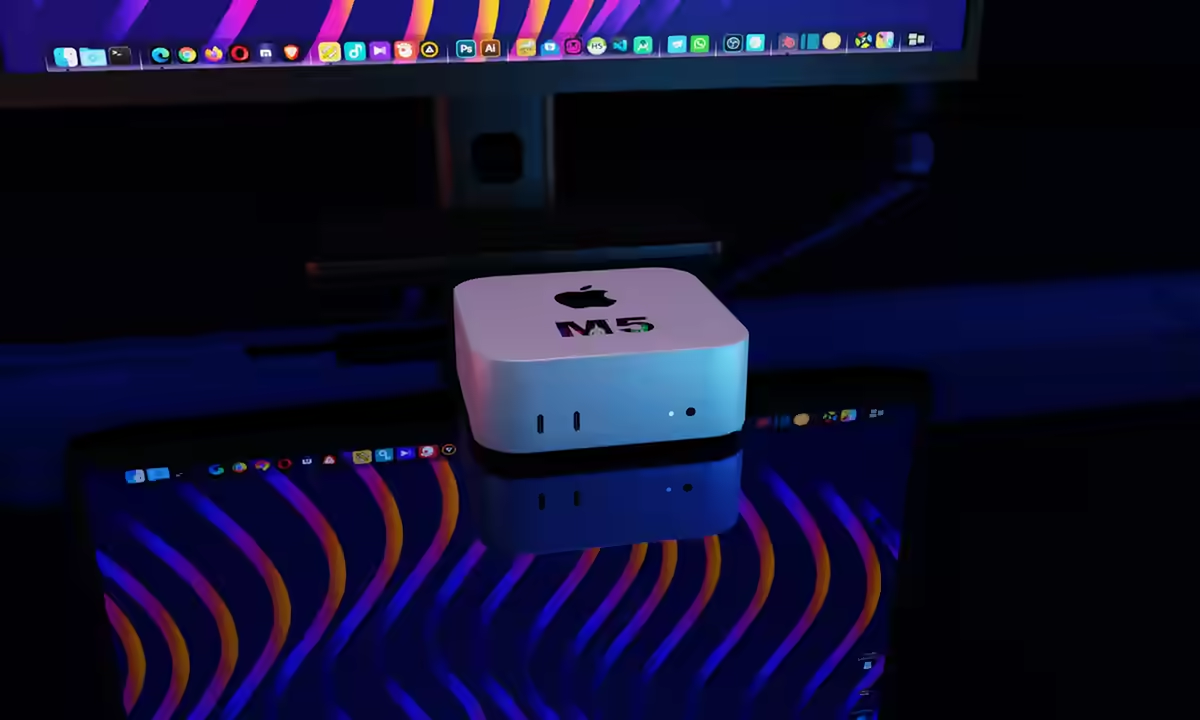
Apple opened preorders on August 25 for new Mac mini and Mac Studio systems that put local AI development and execution at the center of the desktop pitch. The mini now comes with M6 or M5 Pro, while the Studio moves to M5 Max and M5 Ultra. Deliveries begin on September 22; the 512GB Studio configuration follows in late October.² ³
Listed US base prices run from $899 for the M6 Mac mini to $5,499 for the M5 Ultra Mac Studio. Those prices do not buy the maximum advertised memory. M6 tops out at 32GB, while M5 Ultra can be configured with 512GB. Apple has not listed the price of that configuration in its release.² ³
Memory capacity sets the clearest boundary on which models can run. The CPU and GPU in an M-series chip draw from the same pool, allowing model weights and context to occupy unified memory instead of fitting into separate VRAM. Speed, software support, and cost still qualify that advantage. Every performance comparison available at launch came from Apple testing on preproduction machines.¹ ² ³
Four tiers of memory and price
The M6 Mac mini begins at $899 with 16GB and supports up to 32GB. Its chip has a 12-core CPU, 12-core GPU, two 16-core Neural Engines, and up to 170GB/s of memory bandwidth. Apple positions it for building agents and running inference on device.¹ ² ⁴
The M5 Pro mini starts at $1,699 and raises the ceiling to 64GB, with up to 18 CPU cores, 20 GPU cores, and 307GB/s. It also replaces Thunderbolt 4 with Thunderbolt 5, which is required for the low-latency clustering route featured in Apple's launch.² ⁴
Mac Studio with M5 Max starts at $2,499, supports up to 128GB, and offers 614GB/s. M5 Ultra goes further: it begins at $5,499, links two dual-die M5 Max chips into a four-die design, includes as many as 80 GPU cores, and reaches 1.2TB/s of memory bandwidth.¹ ³ ⁵
In the 512GB configuration, the CPU and GPU access the same unified memory pool. Apple says that capacity can hold open-weight models with hundreds of billions of parameters.¹ ³ Fitting a model establishes that execution is possible. It does not say how many tokens per second the system will generate, how much room remains for context, or whether the output matches the quality of a remote service.
The hardware targets the development cycle
Apple introduced the desktops alongside a software stack that includes MLX, Core ML, Metal, Xcode, and the new Core AI framework. Its releases say developers can run and fine-tune models on a Mac, then integrate their own models into applications.¹ ³
Those jobs make different demands. Inference reads trained weights to produce a response. Fine-tuning modifies part of a model's behavior with additional data and usually requires more memory and compute. Training a frontier model from scratch remains a data-center undertaking; Apple did not demonstrate that task on one Studio.
The launch also groups unlike local workloads under “AI performance.” Compiling in Xcode leans heavily on the CPU. Image generation and LLM prompt processing use the GPU and its Neural Accelerators. Apple Intelligence routes work across the Neural Engine and other components depending on the feature. One aggregate multiplier cannot describe all of them equally.
Our June survey of local AI explained why runtime, quantization, and memory bandwidth can matter as much as a chip's name. The refresh raises the hardware ceiling, while each model still needs a Metal- or MLX-optimized implementation to use it well.
Thunderbolt 5 connects Macs at a communication cost
Since macOS 26.2, MLX has offered the JACCL backend for RDMA over Thunderbolt 5. RDMA lets one machine access memory regions on another with less CPU involvement. The project's documentation presents that path for tensor parallelism, training, and distributed inference.⁶
Four boxes do not behave like a frictionless single GPU. Work has to be partitioned, and data crosses cables between stages. The topology requires appropriate links between nodes. MLX documentation still instructs users to enable RDMA from Recovery and configure the interfaces before launching a cluster.⁶
Apple says four Mac Studio systems provide up to three times the inference performance of one.³ The result falls short of linear scaling, and the release does not name the model, context size, power draw, or complete configuration used for the measurement.
There is a practical distinction at the low end. Only the M5 Pro Mac mini includes Thunderbolt 5; the M6 model has Thunderbolt 4.² ⁴ The $899 desktop therefore lacks the low-latency RDMA path Apple emphasizes for clusters.
Apple supplied the first benchmarks
For M6 Mac mini, Apple advertises up to four times the AI performance of M4 and nearly 30 percent more peak GPU AI compute than M5. The M5 Max Studio is said to process LLM prompts up to 3.9 times as fast as M4 Max; M5 Ultra reaches up to four times the M3 Ultra result in the same LM Studio test.¹ ² ³
The footnotes say Apple tested preproduction systems in July and August with selected applications and specific configurations. Apple's comparisons do not report token throughput, wall power, noise, cluster stability, or performance across quantization levels. Independent tests of the final products will still be needed to compare cost with completed work.
Local execution moves costs rather than removing them. A developer avoids provider token charges for that workload, then pays upfront for memory and compute, supplies electricity, and manages models, storage, and updates. Prompts can remain on the machine when the entire pipeline is local; applications, telemetry, and model downloads may still use a network. The resulting privacy depends on the entire implementation.³
Sources
- Apple introduces M6 and M5 Ultra for a big leap in performance and AI compute · Apple Newsroom · https://www.apple.com/newsroom/2026/08/apple-introduces-m6-and-m5-ultra-for-a-big-leap-in-performance-and-ai-compute/ · Aug. 25, 2026
- Apple unveils a more powerful Mac mini featuring the all-new M6 and M5 Pro · Apple Newsroom · https://www.apple.com/newsroom/2026/08/apple-unveils-a-more-powerful-mac-mini-featuring-the-all-new-m6-and-m5-pro/ · Aug. 25, 2026
Show 5 more sourcesHide sources
- Apple introduces new Mac Studio with M5 Max and M5 Ultra · Apple Newsroom · https://www.apple.com/newsroom/2026/08/apple-introduces-new-mac-studio-with-m5-max-and-m5-ultra/ · Aug. 25, 2026
- Mac mini · Apple · https://www.apple.com/mac-mini/ · accessed Aug. 26, 2026
- Mac Studio · Apple · https://www.apple.com/mac-studio/ · accessed Aug. 26, 2026
- MLX distributed communication documentation · MLX · https://github.com/ml-explore/mlx/blob/main/docs/src/usage/distributed.rst · accessed Aug. 26, 2026
- Apple's new desktop computers are designed specifically for local AI development · Ars Technica · https://arstechnica.com/apple/2026/08/with-new-mac-studio-and-mac-mini-apple-leans-hard-into-local-ai-inference/ · Aug. 25, 2026