Waymo expands lobbying as robotaxi rules remain fragmented
The company reported $2.01 million in federal lobbying expenses for the first half of 2026. The filings show its agenda and targets, not influence or local spending.
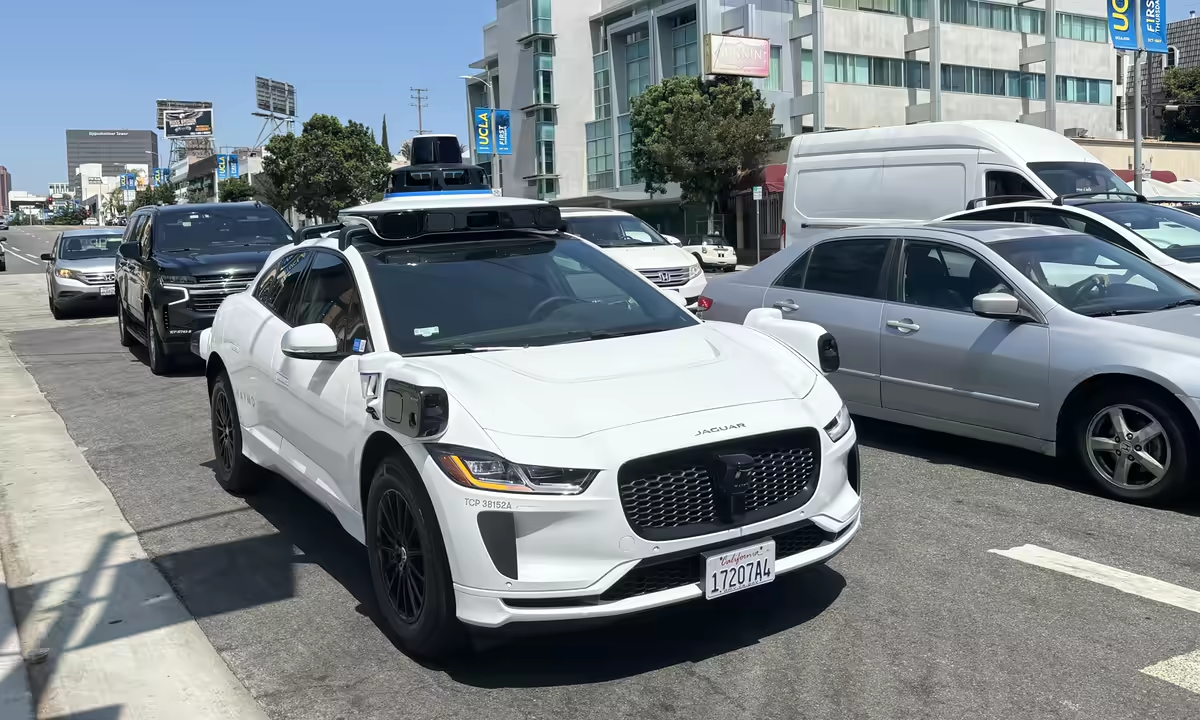
Waymo reported $1.08 million in federal lobbying expenses for the second quarter of 2026, according to its July 20 filing. That was 107.7% above the $520,000 reported for the same period in 2025. First-half spending rose from $1.04 million to $2.01 million, an increase of 93.3%.¹ ²
The disclosures show where the company focused its Washington representation while expanding its robotaxi service. The second-quarter list includes Congress, the White House, the Department of Transportation, NHTSA, the Commerce Department and its Bureau of Industry and Security, the FCC, and USTR. Vehicle safety, accessibility, privacy, connectivity, and supply chains appear among the reported issues, alongside specific bills.¹
The increase measures federal expenses reported under the Lobbying Disclosure Act. It excludes any spending Waymo may incur in state capitals or city halls and does not reveal what was said in each meeting. It also does not establish that an agency adopted the company’s position. The forms document amounts, issues, and government bodies contacted.
Expenses and income must be kept separate
Waymo uses line 13 of the LD-2 form for its good-faith estimate of total lobbying expenses under LDA method A. Organizations lobbying on their own behalf use this field. Amounts of $5,000 or more are rounded to the nearest $10,000.¹ ²
Outside lobbying firms report a different measure: income received from the client, on line 12. Holland & Knight, Monument Advocacy, and McLarty Inbound reported a combined $180,000 in the first quarter of 2025 and $190,000 in the second. S-3 Group, retained since October 2025, reported income in the first two quarters of 2026. Holland & Knight reported an April 24 termination in a filing submitted May 21, while Greenberg Traurig’s engagement began May 1. Outside-firm income totaled $220,000 in each of the first two quarters of 2026.¹ ²
Adding that $220,000 to line 13 would count expenses already included in Waymo’s total a second time. The 93.3% comparison uses only the organization’s matching line across both years. It reconciles with the 93% calculation reported by the Financial Times and republished by Folha de S.Paulo.⁷
The forms leave an important gap. They do not allocate the $1.08 million among in-house staff, hired firms, and individual issues. Firm-reported income accounts for part of the total, but the remainder cannot be assigned to a particular campaign or proposal from these records.
The federal agenda starts with the vehicle
Waymo’s own filing became more detailed in 2026. Its second-quarter entry cites H.R. 7389, H.R. 7390, H.R. 8730/S. 4429, H.R. 8870, and S. 4784. The hired firms also reported work on autonomous-vehicle development, testing and deployment, federal transportation reauthorization, accessibility, trade, and tariffs.¹
In February, Waymo chief safety officer Mauricio Peña presented the company’s public position to the Senate. He asked Congress to use the next surface transportation reauthorization to create a national autonomous-vehicle framework. Waymo’s proposal calls for a federal safety baseline built around safety cases, a national data repository, updated Federal Motor Vehicle Safety Standards for vehicles without manual controls, and accessibility rules.³ These are corporate requests. The lobbying reports neither predict their passage nor determine the final text of legislation.
Federal agencies already have defined responsibilities. NHTSA regulates motor-vehicle and equipment safety, retains defect and recall authority, and can enforce compliance with federal standards. The agency describes states and local governments as handling areas that include licensing, registration, traffic laws, and operational or infrastructure barriers.⁴
That split means a national standard negotiated in Washington would not by itself authorize paid rides in every city. A vehicle can be subject to federal safety requirements while a service depends on the laws and permits of the state where it operates. Depending on local law, cities can also participate in decisions about for-hire transportation, road management, and pickup space.
The LDA reports capture only the federal side of this map. DOT and NHTSA contacts indicate work on the vehicle and its national regulatory treatment. Commerce, BIS, and USTR add supply-chain and trade policy to the agenda. Operating approvals issued outside Washington belong to separate records and proceedings.
Waymo and Uber pursue different models while partnering
Waymo combines development of the autonomous-driving system with its own ride-hailing platform. Uber describes a different business architecture. In May, it presented a hybrid network in which autonomous vehicles and human drivers serve riders, with AV availability limited to selected areas and times.⁵ The commercial contest covers who aggregates demand, manages fleets, and controls the customer relationship.
The companies also continue to work together. In July, Uber said riders in Austin and Atlanta could opt in to receive a Waymo vehicle through its app.⁶ That commercial partnership can coexist with regulatory interests and distribution strategies that do not always align. Waymo’s filings do not record Uber’s position or show that the spending increase was directed against it.
Sources
- Lobbying Disclosure Filings: Waymo LLC, 2026 · LDA.gov · https://lda.gov/api/v1/filings/?filing_year=2026&client_name=Waymo%20LLC&page_size=100 · accessed Aug. 26, 2026
- Lobbying Disclosure Filings: Waymo LLC, 2025 · LDA.gov · https://lda.gov/api/v1/filings/?filing_year=2025&client_name=Waymo%20LLC&page_size=100 · accessed Aug. 26, 2026
Show 5 more sourcesHide sources
- Hit the Road, Mac: The Future of Self-Driving Cars — testimony of Mauricio Peña · U.S. Senate Committee on Commerce, Science, and Transportation · https://www.commerce.senate.gov/meetings/hit-the-road-mac-the-future-of-self-driving-cars/ · Feb. 4, 2026
- Automated Driving Systems · National Highway Traffic Safety Administration · https://www.nhtsa.gov/vehicle-manufacturers/automated-driving-systems · accessed Aug. 26, 2026
- Autonomous vehicles are coming to more cities · Uber · https://www.uber.com/us/en/blog/av-more-cities/ · May 13, 2026
- Riders in Austin and Atlanta can now access Waymo autonomous rides · Uber · https://www.uber.com/us/en/blog/waymo-on-uber/ · July 24, 2026
- Waymo dobra gastos com lobby em batalha dos táxis autônomos com a Uber · Financial Times / Folha de S.Paulo · https://www1.folha.uol.com.br/mercado/2026/08/waymo-dobra-gastos-com-lobby-em-batalha-dos-taxis-autonomos-com-a-uber.shtml · Aug. 22, 2026