The dead nuclear plant betting on laser fusion
Germany has picked the grounds of the Biblis nuclear station, shut down in 2011, for its national laser fusion hub. Focused Energy calls the project the world's first commercial plant, but its roadmap does not put the first megawatt-hour on the grid until 2037. Between laboratory ignition and that milestone sits a list of unsolved problems.
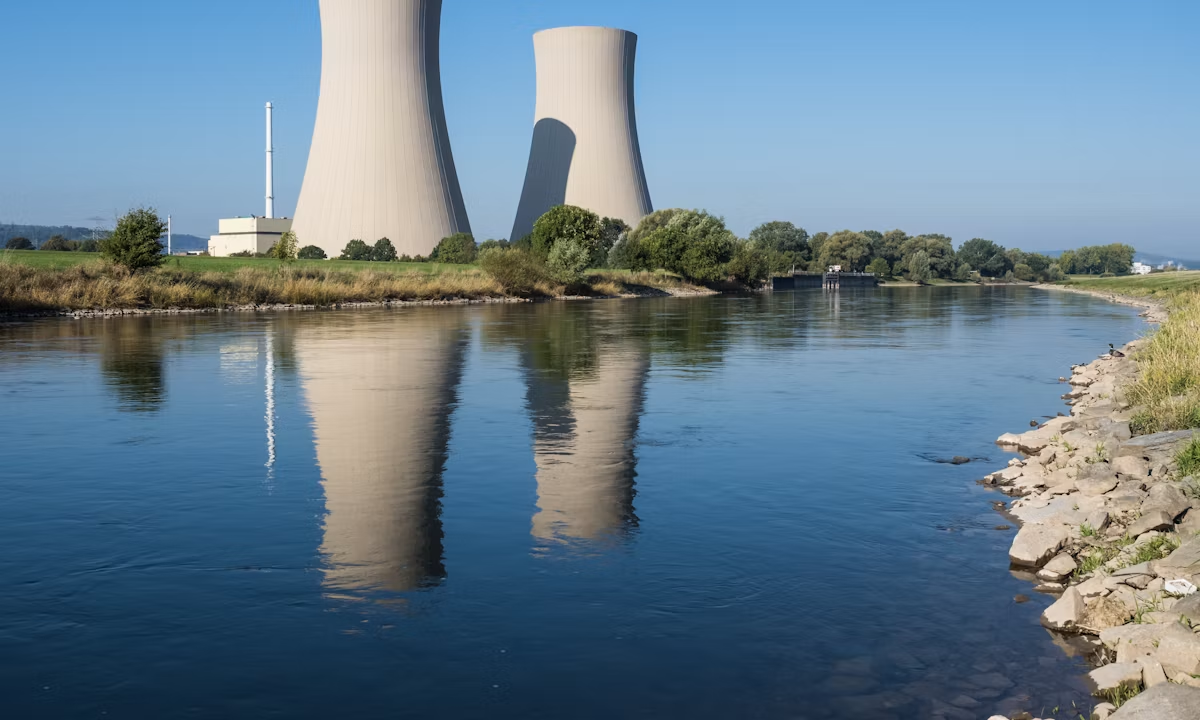
On July 29, Germany's federal research ministry named the sites for its three national fusion hubs. Magnetic fusion goes to the Max Planck Institute for Plasma Physics in Bavaria. Materials and the fuel cycle go to KIT in Karlsruhe. Laser fusion goes to Biblis, in southern Hesse, on the grounds of a nuclear station that lost its license to generate power on August 6, 2011 and has been coming down since 2017.¹ ⁸
The place where Germany buried fission is now the place where it is betting on fusion. The choice wasn't made for the irony. It was made for reinforced concrete, a grid connection and Rhine water.
On that site, Focused Energy, a TU Darmstadt spin-off founded in 2021, says it will build the world's first commercial laser fusion power plant by the mid-2030s.² ⁴ Its own roadmap, however, puts a pilot plant in 2035 and the first megawatt-hour on the grid in 2037.⁵ The sentence puts two very different things side by side: a site that exists and a power plant that exists nowhere.
What Biblis was
Two pressurized water reactors. Unit A came online in 1974, unit B in 1976, for a combined 2,525 megawatts of gross electrical output.⁸ Both dropped off the grid in March 2011, after Fukushima, and lost their generating authorization that August under the 13th amendment to Germany's atomic law.⁸
Dismantling only got moving on March 30, 2017, when the decommissioning and teardown permits came through.⁸ The controlled area alone will yield roughly 340,000 tonnes of material, of which about 5,800 tonnes end up as radioactive waste bound for final disposal.⁸ The third of four cooling towers came down in December 2025; the last fell on January 16, 2026.²³ The teardown is supposed to finish in 2032.¹⁸
One part of the site isn't going anywhere, though. The Biblis interim storage facility holds 102 CASTOR V/19 casks of spent fuel and, since November 2020, six CASTOR HAW28M casks of vitrified waste returned from reprocessing abroad.⁹ Its storage license runs to 2046.⁹ The fusion campus will be born with that neighbor.
Why a closed nuclear plant makes a good site
The advantages are a good deal more prosaic than the technology.
There is a turbine hall. There are warehouses. There are two reactor containment structures in thick reinforced concrete, a high-voltage connection built for the two reactors that used to run there, cooling water, industrial zoning, and a workforce trained to work on a nuclear site. A feasibility study run by Arthur D. Little with Focused Energy proposes exactly what you would expect from that list: don't restore the site to greenfield condition, keep the turbine halls and containment structures, and fill them with laser laboratories, target fabrication and laser test stations.⁷
The landowner has a direct stake in how this ends. RWE invested in Focused Energy in October 2025 and put a further €60 million into the May 2026 Series A, saying that if the site were chosen as the hub it would speed up decommissioning so the existing nuclear infrastructure could be adapted for fusion as early as possible.³
The physical plan unfolds in two stages: a test facility in one of the units, where the components will be integrated and refined, including the array of 1,152 individual lasers, and then the larger reactor in the other unit.¹⁸
Inertial fusion in one paragraph
There are two main routes to fusing hydrogen on Earth. The magnetic route holds a thin plasma with magnets for seconds or minutes; that is ITER and Wendelstein 7-X. Inertial fusion does the opposite. It takes a millimeter-scale capsule of deuterium and tritium and crushes it with laser light in billionths of a second, until the center gets hot enough to ignite and the burn spreads through the compressed fuel.
NIF, in California, does this indirectly: its 192 beams enter a hohlraum, which converts the light into X-rays, and those X-rays do the compressing.¹¹ Focused Energy picked the direct route, with the laser hitting the capsule without an intermediary. The 2023 paper in which the company laid out its approach describes proton fast ignition specifically, a scheme that separates compression from heating in order to reach the high gains, above 100, that the company itself identifies as the requirement for commercial fusion.⁶ In its 2026 public materials and in a February interview with its CEO, the description has shifted to direct drive with central hotspot ignition.⁵ ⁷ Changing course is ordinary in frontier engineering. It is still worth noting that the course changed.
What has actually been proven
On December 5, 2022, NIF delivered 2.05 megajoules of laser energy to a target and harvested 3.15 megajoules of fusion energy.¹¹ It was the first time a capsule gave back more than it received. The record came on April 7, 2025: 2.08 megajoules delivered, 8.6 megajoules released, a target gain of 4.13.¹² Through June 20, 2026, eleven shots had achieved ignition.¹¹
None of those numbers is inflated, and Focused Energy is correct when it says laser fusion is the only approach to demonstrate a target gain above 1.⁴ The catch is in what the word "gain" is counting.
Target gain compares fusion energy with the laser energy delivered to the capsule. It says nothing about the electricity drawn from the grid. NIF's capacitor banks store about 400 megajoules to deliver roughly 2 megajoules to the target, which works out to 0.5 percent wall-plug efficiency.¹³ So the best shot in history released 8.6 megajoules inside a facility that pulled something like 400 megajoules off the grid. John Holdren, who ran the White House science office, does the arithmetic generously: converted to electricity, those 8.6 megajoules would come to about 5 megajoules, roughly an eightieth of the electricity the shot consumed.¹⁴
Four numbers that still don't add up
Cadence. On a good day, with a large dedicated crew, NIF manages two shots a day. A power plant would need something like ten per second.¹⁴ Thomas Forner, CEO of Focused Energy, is upfront about what that implies: around a million capsules a day, made, in his words, the way cars are made.⁷
Target cost. A fusion capsule today runs about $10,000. For a plant to work, it has to cost cents.¹⁴ That is six orders of magnitude. It doesn't hinge on new physics so much as on manufacturing at scale, which makes it a different kind of hard.
Laser efficiency. NIF's 0.5 percent comes from flash lamps pumping neodymium-doped glass, 1990s technology built to deliver infrequent, high-energy shots, not to fire continuously. A plant driver has to be a different machine. In December 2024 Focused Energy signed a $40 million agreement with France's Amplitude, financed by the German innovation agency SPRIND, for two kilojoule-class lasers designed to fire one shot every 60 seconds.²¹ That is a long way past NIF's two shots a day and still 600 times short of the ten a second a plant would need. The arithmetic is unforgiving: if the laser converts 0.5 percent of what it draws, no plausible target gain balances the plant's books. Both numbers have to move together.
Tritium. Deuterium comes out of seawater and is cheap. Tritium barely exists in nature, decays with a half-life of 12.3 years, and the world's civilian stock is 25 to 30 kilograms. Canada produces about 2 kilograms a year as a CANDU byproduct, most of it already spoken for by ITER, and existing reserves shrink by roughly 5 percent a year through decay alone. A one-gigawatt plant may burn more than 55 kilograms a year.²⁰ The answer is the breeding blanket, a lithium layer around the chamber that turns neutrons into fresh fuel. The physics is understood; the industrial-scale demonstration is not.
Two public calendars
Focused Energy's public roadmap is specific: first laser at Biblis in 2028, first light in the diagnostics chamber in 2031, implosion in 2033, pilot plant in 2035, first megawatt-hour on the grid in 2037.⁵ In the February 2026 interview, Forner puts technology readiness level 6 around 2030 and the prototype at 2035 or 2036.⁷
On the day the hub was announced, the public broadcaster hessenschau reported the federal goal as a first German fusion power plant running in the 2040s.¹⁷ Two public calendars, close to a decade apart, surfaced in the same week.
The money comes at two scales as well. The federal ministry is putting roughly €125 million into the first round across the three hubs, with the program widening in six phases through 2029;¹ the Fusion Action Plan of October 2025 sets aside more than €2 billion over that same horizon.¹⁰ Hesse committed €20 million for 2025 in the memorandum signed that March.¹⁹ Focused Energy raised $240 million in its Series A and, alongside the hub announcement, said it would invest €200 million of private money over two years and around €500 million by 2030.² ⁴ Against all of that, the Hessian climate council estimates a cost of at least €20 billion per reactor.¹⁵
The rule change almost nobody covered
The Fusion Action Plan, published on October 1, 2025, proposed keeping fusion facilities under Germany's radiation protection act rather than its atomic act; the legislative process to establish that framework is expected to conclude in 2026.¹⁰
This matters more than it sounds. A dedicated framework could reduce permitting time and cost, especially at a site with existing nuclear infrastructure and an operator experienced in regulatory approvals.³ Forner says the International Atomic Energy Agency has called Biblis a flagship project.⁷
A lighter regime is not the same as no regulation, and the critics' most concrete technical objection lies precisely there: the tritium inventory.
Who disagrees, and on what grounds
On November 28, 2024, the scientific climate council of the Hessian state government published an opinion based on a study it commissioned from the Öko-Institut. The conclusion is blunt: fusion won't contribute noticeably to state climate targets, which are set for 2045, because a first reactor is unlikely before 2043 and would cost at least €20 billion.¹⁵ The opinion also flags a reactor's tritium inventory as a hard-to-control reservoir for hydrogen bomb production.¹⁵ Sven Linow, who chairs the council, put it this way: "It is currently still very uncertain whether nuclear fusion reactors can ever be technically realized and economically deployed."¹⁵
BUND Hesse, an environmental group, was briefer. Werner Neumann, its energy specialist, called fusion "an unrealistic, expensive and radioactive dream."¹⁶
Holdren, writing for Harvard's Belfer Center in April 2026, said he would bet against seeing a successful commercial fusion reactor before 2050.¹⁴ In July, the German magazine t3n published a critique of how the federal program is designed, noting in passing that former federal research minister Bettina Stark-Watzinger now works for Focused Energy.²²
The view from Biblis itself is different. The municipality lost its largest employer and its largest source of revenue when the plant closed, and mayor Konstantin Großmann sees the hub as a chance for the town to establish itself as a technology and research location.¹⁷ Steffen Kanitz, an RWE board member, frames the project as a source of future jobs for staff still working at the site.¹⁸
Verdict
The real-estate half of this story is solid. Reusing a nuclear site mid-teardown, with grid, water, reinforced structures and existing nuclear infrastructure, instead of restoring it to greenfield condition, is sound engineering and better economics. If Germany is going to spend €2 billion trying to industrialize fusion, Biblis is a reasonable place to spend it.
The energy half is a bet, and it deserves to be described as one. What has been demonstrated is that a capsule can return four times the laser energy delivered to it, inside a building that consumes eighty times more electricity than it harvests. What is missing is ten shots a second, targets that cost cents, a laser from a different generation, and a tritium cycle that feeds itself. None of those four has been solved, and three of them are manufacturing and systems engineering rather than physics. That is good news about the nature of the problem and no news at all about the schedule.
There is a reason for the hurry. Firm power is now something buyers compete for in a market where AI data centers buy electricity that never sleeps, and that appetite is what makes a 2037 project look near-term to an investor.
Focused Energy's own site carries the line "the science is solved; we're building the power plant."⁵ With the right accounting, the first half holds up. The second half is the entire job.
Sources
- Bär: "Drei neue Fusionshubs vernetzen Wirtschaft und Wissenschaft auf dem Weg zum Fusionskraftwerk." (release 39/2026: three hubs, about €125 million in the first round, six phases through 2029) · BMFTR · https://www.bmftr.bund.de/SharedDocs/Pressemitteilungen/DE/2026/07/Fusion.html · 2026-07-29.
- Biblis wird zum Laserfusions-Hub · Focused Energy · https://www.focused-energy.co/news-release/biblis-wird-zum-laserfusions-hub · accessed 2026-08-17.
Show 21 more sourcesHide sources
- RWE increases investment in Focused Energy (additional €60 million; commitment to adapt decommissioning) · RWE · https://www.rwe.com/en/press/rwe-ag/2026-05-27-rwe-increases-investment-in-focused-energy/ · 2026-05-27.
- Focused Energy Sets a New Benchmark: $240 Million for the Largest Series A Financing in the Global Fusion Industry · Focused Energy · https://www.focused-energy.co/news-release/focused-energy-sets-a-new-benchmark-240-million-for-the-largest-series-a-financing-in-the-global-fusion-industry · 2026-05-27.
- Company site carrying the 2028 to 2037 milestone roadmap · Focused Energy · https://www.focused-energy.co/ · accessed 2026-08-17.
- Ditmire, T.; Roth, M. et al. Focused Energy, A New Approach Towards Inertial Fusion Energy · Journal of Fusion Energy 42(2), art. 27 · https://link.springer.com/article/10.1007/s10894-023-00363-x · 2023 · DOI: 10.1007/s10894-023-00363-x.
- Biblis and Germany's return (interview with Thomas Forner) · Nuclear Engineering International · https://www.neimagazine.com/advanced-reactorsfusion/biblis-and-germanys-return/ · 2026-02-11.
- Stilllegung und Abbau des Kernkraftwerkes Biblis (units A and B, 2,525 MW, permits from 2011, 2017 and 2020, material volumes) · Hessisches Ministerium für Landwirtschaft und Umwelt · https://landwirtschaft.hessen.de/umwelt/kernenergie-und-strahlenschutz/stilllegung-und-abbau-des-kernkraftwerkes · accessed 2026-08-17.
- Zwischenlager Biblis (102 CASTOR V/19, six CASTOR HAW28M, license to 2046) · Bundesamt für die Sicherheit der nuklearen Entsorgung (BASE) · https://www.base.bund.de/de/zwischenlager/aufbewahrung/standorte-zwischenlager/zwischenlager-biblis/zwischenlager-biblis_inhalt.html · accessed 2026-08-17.
- Aktionsplan für das weltweit erste Fusionskraftwerk in Deutschland (more than €2 billion through 2029; regulation under the radiation protection act) · BMFTR · https://www.bmftr.bund.de/SharedDocs/Kurzmeldungen/DE/2025/10/011025-aktionsplan-fusion.html · 2025-10-01.
- Achieving Fusion Ignition (2022-12-05 shot: 2.05 MJ in, 3.15 MJ out; 192 beams; eleven ignitions through 2026-06-20) · Lawrence Livermore National Laboratory / NIF · https://lasers.llnl.gov/science/achieving-fusion-ignition · accessed 2026-08-17.
- NIF Sets Power and Energy Records (2025-04-07: 2.08 MJ delivered, 8.6 MJ released, gain 4.13) · Lawrence Livermore National Laboratory / NIF · https://lasers.llnl.gov/about/keys-to-success/nif-sets-power-energy-records · accessed 2026-08-17.
- Fundamental Research in High Energy Density Science, Appendix A ("NIF's capacitor banks store ~400 MJ of energy and its laser delivers about 2 MJ… 0.5 percent wall-plug efficiency") · National Academies of Sciences, Engineering, and Medicine · https://www.nationalacademies.org/read/26728/chapter/9 · 2023.
- Holdren, J. P., note on the claimed imminence of commercial fusion energy (shot cadence, capsule cost, NIF's electricity balance and his bet against a commercial reactor before 2050) · Belfer Center, Harvard Kennedy School · https://www.belfercenter.org/research-analysis/notes-recent-h%79pe-about-imminence-commercial-fusion-energy · 2026-04-21.
- Kernfusion kann absehbar keinen Beitrag zur Erreichung der hessischen Klimaziele leisten (opinion based on an Öko-Institut study; minimum cost of €20 billion; statement by Sven Linow) · Wissenschaftlicher Klimabeirat der Hessischen Landesregierung · https://www.klimabeirat-hessen.de/presse/kernfusion-kann-absehbar-keinen-beitrag-zur-erreichung-der-hessischen-klimaziele-leisten · 2024-11-28.
- Kernfusion ist unrealistischer, teurer und strahlender Traum (statement by Werner Neumann) · BUND Hessen · https://www.bund-hessen.de/pm/news/kernfusion-bund-begruesst-stellunnahme-klimarat-hessen/ · 2024-11-28.
- Biblis wird Standort für Forschung neuer Energiequelle: Laserfusions-Hub (€125 million; federal target for the 2040s; mayor Konstantin Großmann) · hessenschau · https://www.hessenschau.de/wirtschaft/biblis-wird-standort-fuer-forschung-neuer-energiequelle-laserfusions-hub-v1,fusionsforschung-biblis-100.html · 2026-07-29.
- Energiewende: Ab 2035 soll weltweit erstes Kernfusion-Kraftwerk in Biblis Strom liefern (1,152 individual lasers; cooling towers; statements by Forner, Roth and Kanitz) · hessenschau · https://www.hessenschau.de/wirtschaft/energiewende-ab-2035-soll-weltweit-erstes-kernfusion-kraftwerk-in-biblis-strom-liefern--v1,biblis-kernfusion-100.html · 2025-12-19.
- Laser-based fusion plant planned for Biblis site (memorandum of 2025-03-13; €20 million from Hesse for 2025) · World Nuclear News · https://www.world-nuclear-news.org/articles/laser-based-fusion-plant-planned-for-biblis-site · 2025-03-14.
- Loy, T. Fusion Energy Leadership Through Tritium Production Capacity (civilian stock of 25 to 30 kg; about 2 kg/year in Canada; 5 percent annual decay; more than 55 kg/year for 1 GW) · Federation of American Scientists · https://fas.org/publication/fusion-energy-leadership-tritium-capacity/ · 2024-11-26.
- Focused Energy and Amplitude Enter $40 Million Agreement to Advance High-Energy Lasers Beyond the State-of-the-Art for Inertial Fusion Energy (two kilojoule-class lasers, one shot every 60 seconds, SPRIND financing, San Francisco Bay Area facility) · Focused Energy · https://www.focused-energy.co/news-release/focused-energy-and-amplitude-enter-40-million-agreement-to-advance-high-energy-lasers-beyond-the-state-of-the-art-for-inertial-fusion-energy · 2024-12-17.
- Stieler, W. Kernfusion in Deutschland: Darum beruht der Plan auf fragwürdigen Annahmen · t3n · https://t3n.de/news/fusionskraftwerk-bis-2039-warum-deutschlands-24-milliarden-plan-scheitern-wird-1751607/ · 2026-07-07.
- Der letzte Biblis-Turm ist gefallen: Abriss mit fadem Beigeschmack (the fourth and final tower fell on 2026-01-16) · hessenschau · https://www.hessenschau.de/panorama/der-letzte-biblis-turm-ist-gefallen---abriss-mit-fadem-beigeschmack-v1%2Ckuehlturm-biblis-beigeschmack-100.html · 2026-01-16.