The US promised a useful quantum computer by 2028
The Department of Energy has set 2028 for the first fault-tolerant quantum computer that could do science, with logical qubits “numbering in the low hundreds.” IBM, slated for the largest federal award in the sector, publicly plans 200 logical qubits for 2029.
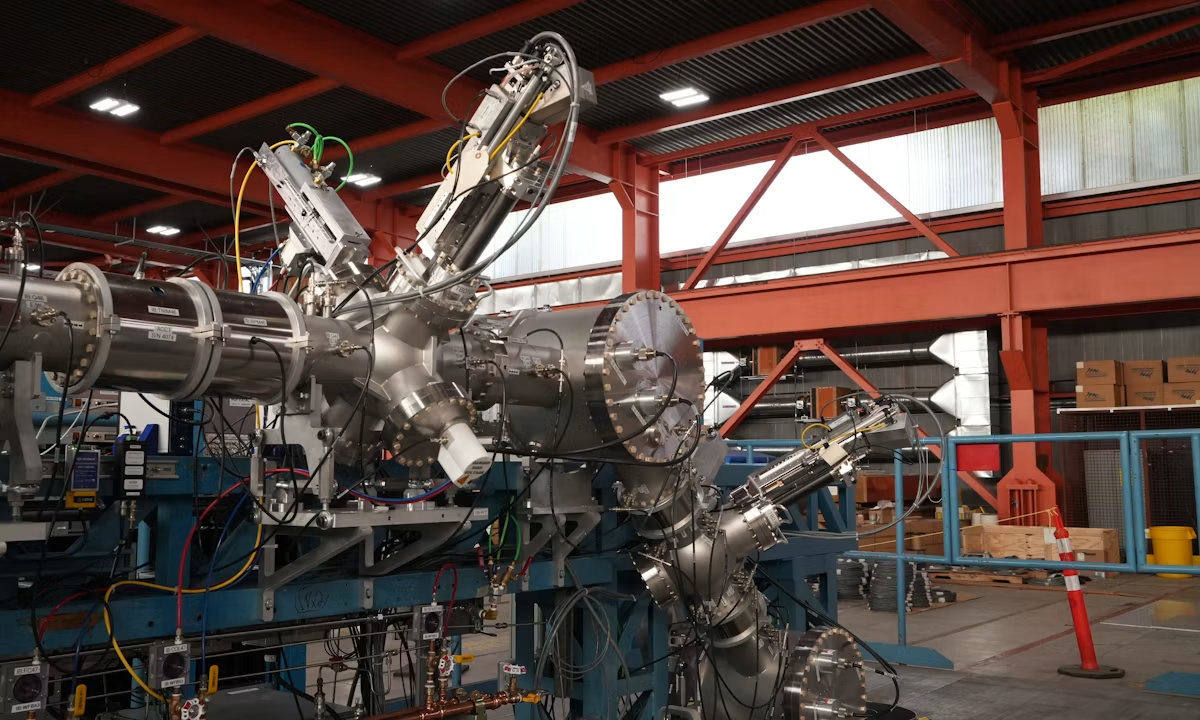
On June 22, the White House signed an executive order on quantum computing. The next day, the Department of Energy said what it intends to do with it: deliver, by 2028, "the world's first fault-tolerant, scientifically relevant quantum computing capability."¹ ² The program is called Quantum Genesis, and it is the quantum arm of the Genesis Mission, the administration's umbrella for AI-driven science and supercomputing.¹ ⁵
That is two and a half years from the announcement.
Announcing a date costs nothing. What makes this one worth a careful read is that the government put numbers on paper, and numbers can be checked.
The number the government published
The DOE announcement itself is vague where it counts: fault-tolerant systems in 2028, with logical qubits "numbering in the low hundreds."¹ The fine-grained numbers came earlier, and through a different door. On May 15, weeks before the executive order, DOE put out a request for information aimed at companies that could deliver such a system, a market-research instrument meant to shape planning and program design ahead of any solicitation. Responses closed on June 9. What that document describes is unusually precise for a government text: a target of 150 to 250 logical qubits, a computationally universal instruction set, and the ability to run circuits containing at least 10⁵ "hard" operations, meaning T or Toffoli gates, at a logical error rate of 10⁻⁸ per operation.³ The same document estimates that broad scientific impact, in fields such as plasma physics and high-energy physics, will take more than a thousand logical qubits and on the order of 10⁹ hard gates, arriving in the early to mid 2030s.³
The distinction matters: 150 to 250 is the figure the government took to the market to test, not a qualification rule it has signed.
Quantum Genesis has three parts: a milestone-driven hardware contest among companies and institutes, called the DOE Q Competition; a national quantum supercomputing user facility open to researchers and wired into the department's exascale and AI systems; and targeted research on applications in chemistry, materials science, plasma physics and high-energy physics.¹ ⁴ The executive order set the administrative clocks running: 90 days for the Energy Secretary to identify the technical specifications for a QC-ADDS, the quantum computer for application development and discovery science, and to publish a summary of them; 180 days to explore private-sector partnership models and to stand up a national center charged with building the tools that measure how quantum systems perform.²
So the headline deadline is 2028, but the first credibility test falls due at the end of September, when the specification that counts leaves the consultation stage.
Physical qubit, logical qubit
The distance between the two is what this story is made of.
A physical qubit is a piece of hardware: a superconducting circuit chilled to millikelvin, an ion held in an electric field, a neutral atom pinned by lasers. All of them make mistakes at an uncomfortable rate. The best today err somewhere around once in every thousand two-qubit operations, and an interesting scientific calculation needs billions of operations in a row without the errors piling up.
Error correction handles this by spreading one qubit's worth of information across many physical qubits and repeatedly measuring, not the data itself, but the relationships between neighbors, which reveals where an error happened without revealing what is stored. In the surface code the qubits sit on a grid, and the parameter that matters is the code distance: the larger it gets, the more physical qubits it eats and the lower the error of the resulting logical qubit.
None of this works until a turning point is passed. Below threshold, adding physical qubits drives logical error down; above it, every new qubit contributes more noise than protection. Several leading experiments have crossed that line over the past two years, in demonstrations that remain limited.
What has actually been demonstrated
In December 2024, Google's group published the landmark result in Nature: a distance-7 surface code on 101 qubits of the Willow processor, holding a logical error rate of 0.143% ± 0.003% per correction cycle, with error falling by a factor of 2.14 ± 0.02 for every increase of two in code distance. The logical memory outlived the chip's best physical qubit by 2.4 ± 0.3 times.⁹ That is protected memory, not a computation.
In November 2025, the Harvard group, with MIT and QuEra, published a complete architecture in neutral atoms: up to 448 atoms running, on one apparatus, repeated correction in surface codes, logical entanglement through transversal gates and lattice surgery, and universal logic via transversal teleportation with three-dimensional codes.¹⁰ Dolev Bluvstein, the lead author, did not sell it as arrival: "There are still a lot of technical challenges remaining to get to a very large-scale computer with millions of qubits."¹¹
Quantinuum launched Helios on November 5, 2025: 98 physical qubits with all-to-all connectivity and 99.921% two-qubit gate fidelity, the company's own figure.¹² What followed, in two papers from the team, shows why every logical-qubit count needs a caption.
In February 2026, the group published runs with 48 to 94 encoded logical qubits on that machine, built on high-rate iceberg codes, which detect errors, and on a two-level concatenated version, which corrects them. The setup mixes fault-tolerant and partially fault-tolerant components, with post-selection applied to the results.²⁰ In March, another paper from the same team reported what it describes as the first end-to-end execution of algorithms using only fault-tolerant components: the largest circuits ran on 12 logical qubits across 97 physical qubits, with 2,132 physical two-qubit gates in the biggest of them.²¹
The gap between 94 and 12 is the whole problem in miniature. The same hardware yields one number or the other depending on how strict the standard is, because encoded, error-detected, error-corrected and fully fault-tolerant are four different categories that the industry tends to announce with a single word.
Put the ends together and the size of the jump shows up. The clean comparison is the one that uses the same unit: DOE asked the market about 10⁻⁸ error per hard operation, and the logical T gate in that fault-tolerant experiment came in at an infidelity of 2.6(4) × 10⁻³.²¹ That is five orders of magnitude on a comparable metric. Google's 0.143% measures something else, memory held across a correction cycle, and should not be subtracted from that target.
And the requirement is cumulative: 150 to 250 logical qubits, 10⁵ hard operations and 10⁻⁸ error, all on one machine. In the published results so far, the largest fault-tolerant circuits ran on 12 logical qubits with a few thousand physical two-qubit gates, orders of magnitude short of 10⁵ T gates. Any one axis is hard on its own; the target is where all three meet.
The disagreement is about what 100 logical qubits can do
The argument among specialists is not about whether error correction works. It is about what the first handful of logical qubits is good for.
Pranav Gokhale, CTO of Infleqtion, puts scientific value close to the federal target: "100 logical qubits is where we see the advantage," in models of magnetism and high-temperature superconductivity.⁶ Jay Sau, a physicist at the University of Maryland, disagrees with the premise: absent major breakthroughs, "I cannot think of a scientific question a quantum computer can help with in 2028."⁶ Edward Parker, at RAND, lands in between: logical qubits by 2028 are plausible, but they will still be imperfect and noisy.⁶
One reference point helps with the scale. FeMoco, the nitrogenase cofactor that quantum chemistry uses as its benchmark problem, was estimated by Joonho Lee, Craig Gidney and colleagues at roughly four million physical qubits and under four days of runtime, assuming 1-microsecond cycle times and physical gate error rates no worse than 0.1%.¹⁶ Outside basic science, Gidney recalculated the cost of factoring a 2048-bit RSA key in 2025: under a week with fewer than a million noisy qubits, down from the 20 million qubits and eight hours he had estimated in 2019.¹⁷ Neither is what DOE is chasing, but both mark the scale of the applications that tend to show up in industry slide decks.
There is also a case that the target is not absurd. An analysis from NERSC, Berkeley Lab's supercomputing center, mapped the center's actual workload and found materials science, quantum chemistry and high-energy physics accounting for more than half of production; it notes that the quantum resources those problems demand have fallen steadily as algorithms improved, and that meaningful overlap is emerging between hardware roadmaps and what the algorithms ask for.¹⁸ The 2028 goal aims squarely at the bottom edge of that overlap.
Two clocks inside one government
IBM has published the industry's most detailed roadmap since June 2025. Starling, due in 2029 and under construction in Poughkeepsie, is meant to run circuits containing 100 million gates on 200 logical qubits; Blue Jay, set for 2033, is described as 2,000 logical qubits and a billion operations. The path runs through intermediate processors (Loon in 2025, Kookaburra in 2026, Cockatoo in 2027) and through swapping the surface code for qLDPC codes, which the company says cut the number of physical qubits per logical qubit by as much as 90%.¹³ ¹⁴
Set that against the federal target of 150 to 250 logical qubits in 2028. The company with the largest planned award in the American quantum package publishes an equivalent number, in its own promotional material, for the following year.
Then there is a second clock, and it is the more awkward one. DARPA runs the Quantum Benchmarking Initiative, whose stated purpose is to "determine whether it's possible to build an industrially-useful computer by 2033," with usefulness defined as computational value exceeding cost.¹⁵ One US agency has built a verification program to find out whether 2033 is achievable. Another has promised delivery in 2028.
The money arrived before the consensus
On May 21, 2026, the Commerce Department announced letters of intent, not closed contracts, covering $2.013 billion in CHIPS incentives to nine companies, with the government taking a minority, non-controlling equity stake in each: $1 billion to IBM, $375 million to GlobalFoundries, $100 million apiece to Atom Computing, D-Wave, Infleqtion, PsiQuantum and Quantinuum, up to $100 million to Rigetti, and up to $38 million to Australia's Diraq.⁷ The largest of those does not buy the 2028 machine: IBM would put the money into a new foundry subsidiary for quantum-grade superconducting wafers, which is manufacturing capacity. The list spans superconducting circuits, trapped ions, neutral atoms, photonics and silicon spins, and the CHIPS R&D Office calls this a portfolio approach: the government is spreading risk across competing modalities instead of picking one.⁷
Quantum Genesis itself is a different matter. Neither the executive order nor the DOE announcement identifies a dedicated funding source for the program.⁵ And the fiscal 2027 budget is still only a request, pending Congress: the department proposes $1.2 billion for a new office of AI and quantum, while the Office of Science would drop 13%, to $7.1 billion, against the amount enacted for 2026.⁸ Carl Coe, DOE's chief of staff, was blunt at an April event: "Even though the White House allocated a good amount, we need a lot more."⁸ On the Hill, the House appropriations committee backed the Genesis Mission's goals but asked for a program-by-program funding briefing, and Democratic members complain that the initiative drains money from research that already exists.⁵
It is the pattern that showed up once frontier computing became a strategic asset: the target gets announced first and the budget gets sorted out later.
In Brazil, the number on the sign is physical
Brazil enters this count through a different door. CIQuanta, the international quantum computing center in João Pessoa, built through a partnership between the science ministry, the state of Paraíba and the Suzhou quantum center in China, will house two machines of 20 and 100 qubits. The schedule released with the project had the equipment arriving in August and assembly finishing by October 2026, on an investment of roughly 150 million reais; the announcement describes the pair as the first in Latin America to go into operation.¹⁹ Once installed, they would matter for training people in the field.
The same ruler applies to that headline. Those hundred qubits are physical qubits. No public data yet says what error rates the machines will deliver, and no quantity of physical qubits becomes a logical qubit without error correction running below threshold. The American target of 150 to 250 is denominated in a different unit, which is exactly why it is hard.
Verdict
The good part of this story is the willingness to write numbers down. Governments usually promise leadership, excellence and the future; this one took 150 to 250 logical qubits, 10⁵ hard operations and an error rate of 10⁻⁸ to the market, and committed in public to logical qubits in the hundreds. That can be falsified. And the national performance assessment center, due at the end of December, addresses exactly the problem the two Quantinuum papers expose: without a common ruler, the same machine is worth 94 or 12 logical qubits depending on who does the counting.
The fragile part is the deadline. On the comparable metric, five orders of magnitude separate the best published logical T gate from the figure DOE took to the market, and the circuit being asked for is orders of magnitude longer than anything yet run under fault-tolerant execution. The public roadmap of the company with the largest award planned by this same government puts that number in 2029. Another agency of that government built an entire program to find out whether 2033 is feasible.
It is worth naming what makes 2028 convenient: it falls inside the current term, and the budget behind the effort is approved one year at a time. A goal like that works well as a mobilizing device and badly as a technical forecast.
If the demonstration lands in 2030, with 200 logical qubits simulating chemistry no classical supercomputer can reach, it will have been one of the fastest advances in the history of computing, and it will still go into the record as a broken promise. The deadline decided that, not the physics.
Sources
- Energy Department Announces Initiative to Create and Deploy the World's First Scientifically Relevant, Fault-Tolerant Quantum Computers (2028 goal; logical qubits "numbering in the low hundreds"; three components; statements by Chris Wright and Michael Kratsios) · U.S. Department of Energy · https://www.energy.gov/science/articles/energy-department-announces-initiative-create-and-deploy-worlds-first · 2026-06-23.
- Ushering in the Next Frontier of Quantum Innovation (executive order; QC-ADDS; 90 days to identify the technical specifications and publicly release a summary, Sec. 4(c); 180 days for partnership models, Sec. 4(d), and for the national performance assessment center, Sec. 4(e)(i)) · The White House · https://www.whitehouse.gov/presidential-actions/2026/06/ushering-in-the-next-frontier-of-quantum-innovation/ · 2026-06-22.
Show 19 more sourcesHide sources
- U.S. Department of Energy Issues RFI for 2028 Fault-Tolerant Quantum Computer (RFI issued 2026-05-15, described as a market research tool to inform strategic planning, program design and future funding mechanisms; responses due 2026-06-09; 150 to 250 logical qubits; 10⁵ T or Toffoli operations; 10⁻⁸ logical error rate; 1,000+ logical qubits and ~10⁹ operations in the 2030s) · Quantum Computing Report · https://quantumcomputingreport.com/u-s-department-of-energy-issues-rfi-for-2028-fault-tolerant-quantum-computer/ · 2026-05.
- DOE Launches "Quantum Genesis" Initiative (DOE Q Competition, national user facility, targeted R&D) · Quantum Computing Report · https://quantumcomputingreport.com/doe-launches-quantum-genesis-initiative/ · 2026-06.
- DOE Launches 'Quantum Genesis' Initiative (no funding mechanism specified; House appropriations committee; Democratic objections; statement by Darío Gil) · AIP FYI · https://www.aip.org/fyi/doe-launches-quantum-genesis-initiative · 2026-06.
- Genkina, D. Trump's Quantum Orders Push Fault Tolerant Qubits Toward 2028 (statements by Pranav Gokhale, Jay Sau and Edward Parker; second executive order on post-quantum cryptography) · IEEE Spectrum · https://spectrum.ieee.org/quantum-computing-trump-executive-orders · 2026-06-30.
- Department of Commerce Announces Letters of Intent with 9 Companies for $2 Billion (letters of intent, not closed contracts; $2.013 billion from the CHIPS R&D Office; minority equity stakes; per-company amounts; IBM's $1 billion earmarked for a quantum foundry subsidiary producing quantum-grade superconducting wafers; stated "portfolio approach" across modalities) · NIST / U.S. Department of Commerce · https://www.nist.gov/news-events/news/2026/05/department-commerce-announces-letters-intent-9-companies-2-billion · 2026-05-21.
- Energy needs 'a lot more' funding to reach Genesis Mission goals, official says (statements by Carl Coe; fiscal 2027 request pending congressional approval: $1.2 billion for the AI and quantum office and Office of Science at $7.1 billion, 13% below the amount enacted for 2026) · FedScoop · https://fedscoop.com/doe-genesis-mission-funding-challenges-aitalks/ · 2026-04-14.
- Acharya, R. et al. (Google Quantum AI). Quantum error correction below the surface code threshold (distance 7 on 101 qubits; 0.143% ± 0.003% per cycle; Λ = 2.14 ± 0.02; logical memory 2.4 ± 0.3 times the best physical qubit) · Nature 638, 920–926 · https://arxiv.org/abs/2408.13687 · 2024-12 · DOI: 10.1038/s41586-024-08449-y.
- Bluvstein, D. et al. A fault-tolerant neutral-atom architecture for universal quantum computation (448 atoms; repeated correction, transversal gates, lattice surgery and transversal teleportation; preprint titled Architectural mechanisms of a universal fault-tolerant quantum computer) · Nature · https://arxiv.org/abs/2506.20661 · 2025-11 · DOI: 10.1038/s41586-025-09848-5.
- Physicists unveil system to solve long-standing barrier to new generation of supercomputers (statement by Dolev Bluvstein; context for the 448-atom experiment) · Phys.org · https://phys.org/news/2025-11-physicists-unveil-barrier-generation-supercomputers.html · 2025-11.
- Quantinuum Launches Helios Quantum Computer with Industry-Leading Fidelity and Singapore Partnership (98 physical qubits with all-to-all connectivity; 99.921% two-qubit gate fidelity; logical-qubit count as announced by the company at launch) · Quantum Computing Report · https://quantumcomputingreport.com/quantinuum-launches-helios-quantum-computer-with-industry-leading-fidelity-and-singapore-partnership/ · 2025-11.
- Engineering Fault Tolerance: IBM's Modular, Scalable Full-Stack Quantum Roadmap (Starling in 2029 with 200 logical qubits and 100 million gates; Blue Jay in 2033; Loon, Kookaburra and Cockatoo; qLDPC with up to 90% fewer physical qubits) · The Quantum Insider · https://thequantuminsider.com/2025/06/12/engineering-fault-tolerance-ibms-modular-scalable-full-stack-quantum-roadmap/ · 2025-06-12.
- IBM lays out clear path to fault-tolerant quantum computing (the company's official roadmap) · IBM Quantum · https://www.ibm.com/quantum/blog/large-scale-ftqc · 2025-06-10.
- Quantum Benchmarking Initiative (stated goal of determining whether an industrially useful computer is possible by 2033; definition of utility; Stage A, B and C structure) · DARPA · https://www.darpa.mil/research/programs/quantum-benchmarking-initiative · accessed 2026-08-17.
- Lee, J.; Berry, D. W.; Gidney, C. et al. Even more efficient quantum computations of chemistry through tensor hypercontraction (FeMoco at roughly four million physical qubits and under four days of runtime) · https://arxiv.org/abs/2011.03494 · 2021-12 revision.
- Gidney, C. How to factor 2048 bit RSA integers with less than a million noisy qubits (under a week with fewer than a million noisy qubits; comparison with the 2019 estimate) · https://arxiv.org/abs/2505.15917 · 2025-05.
- Camps, D.; Rrapaj, E.; Klymko, K. et al. Quantum Computing Technology Roadmaps and Capability Assessment for Scientific Computing – An analysis of use cases from the NERSC workload (materials, quantum chemistry and high-energy physics at more than 50% of the production workload; steady decline in required resources) · NERSC / Lawrence Berkeley National Laboratory · https://arxiv.org/abs/2509.09882 · 2025-09-11.
- Brasil lança centro quântico de R$ 150 milhões com apoio da China na Paraíba (CIQuanta; machines of 20 and 100 qubits; roughly R$ 150 million; equipment arriving in August, assembly through October; the machines described as the first in Latin America to enter operation) · Consecti · https://consecti.org.br/brasil-lanca-centro-quantico-de-r-150-milhoes-com-apoio-da-china-na-paraiba/ · 2026-04-15.
- Dasu, S.; DeCross, M.; Guo, A. Y. et al. (Quantinuum). Computing with many encoded logical qubits beyond break-even (48 to 94 encoded logical qubits on the 98-qubit Helios; high-rate iceberg error-detecting codes and a two-level concatenated version; fault-tolerant and partially fault-tolerant components; post-selection) · https://arxiv.org/abs/2602.22211 · 2026-02-25.
- Perlin, M. A.; He, Z.; Alexiades Armenakas, A. et al. (Quantinuum). Fault-tolerant execution of error-corrected quantum algorithms (end-to-end execution using only fault-tolerant components, on the H2 and Helios processors; 12 logical qubits across 97 physical qubits in the largest case; 2,132 physical two-qubit gates in the largest circuit; logical T gate infidelity of 2.6(4) × 10⁻³) · https://arxiv.org/abs/2603.04584 · 2026-03-04.