Taiwan charges eight over alleged B300 server diversion
Prosecutors say false declarations and an incompatible inspection site cleared 130 units. Eight defendants face export-related charges; there is no verdict.
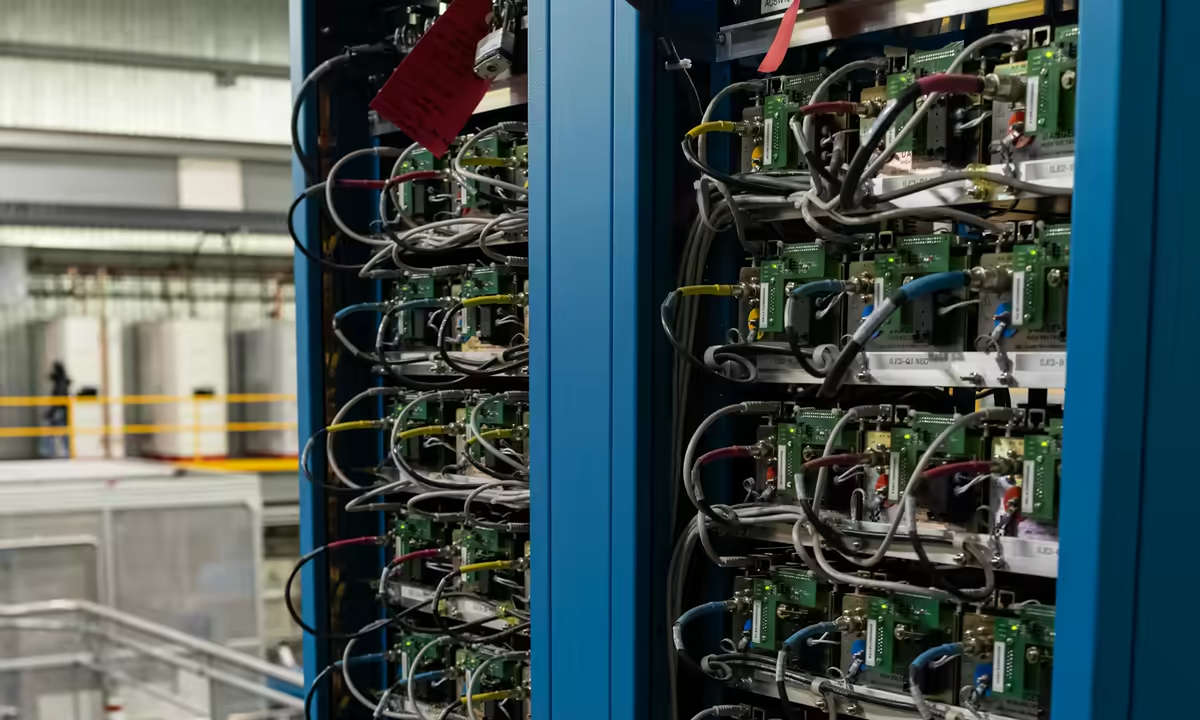
The Keelung District Prosecutors Office closed its investigation into sales and shipments of AI servers equipped with NVIDIA B300 GPUs on 24 August. Its official release charges eight people in the alleged export operation and includes a ninth defendant in a related financial case. Another suspect, described as the de facto controller of one company, remains wanted.¹
Prosecutors allege that an order for 130 Supermicro servers passed buyer and end-use controls through false declarations, withheld information and an inspection site that could not support the purchase. They say 74 units reached customers in China. The other 56 remained in Taiwan after customs required a licence for a declared shipment to Japan.¹
The seven-page document sets out the prosecution case. None of the nine defendants has been tried, and the requested prison terms are not sentences. NVIDIA and Supermicro appear as manufacturers and as the employers of some defendants; neither company was charged in this proceeding.¹
The order was approved in three stages
B300 is an NVIDIA Blackwell Ultra GPU used in AI computing systems.⁶ The Keelung case concerns Supermicro servers built around that component and delivered in three tranches: 2 units, followed by 64 and another 64.¹
The release says the sales policy required a whitelisted buyer, end-user and end-use declarations, and a commitment against resale. Approval ran through the Taiwanese units and the US headquarters of NVIDIA and Supermicro. An order of eight or more servers also required an on-site visit by sales and technical staff.¹
Flying Tiger, a Taiwanese trading company, allegedly identified itself as the end user, named Taiwan as the country of installation and promised not to export or re-export the systems to targets under US sanctions. Prosecutors contend that the intended customers were already in China. A court has yet to examine that assertion.¹
The eight export defendants include a manager in NVIDIA Taiwan’s distribution business and two senior sales executives at Supermicro’s Taiwan subsidiary. Others held roles at the distributor that financed the order, the buyer, the data-centre operator shown during inspection and companies involved in export logistics. The PDF identifies people only by surnames or partially obscured names.¹
The release attributes the conduct to specific individuals. Employees outside the alleged arrangement allegedly approved the purchase based on the information placed before them. The document does not charge either company or attribute knowledge to NVIDIA or Supermicro management.¹
The inspection site could not support the order
A declaration dated 8 September 2025 named Flying Tiger as the end user and a Taiwanese facility as the destination. Representatives visited the site two days later. Prosecutors allege that participants knew a quotation was being presented as a lease and that the available rack space, electrical capacity and network bandwidth could not support 130 systems.¹
According to the PDF, those limitations were withheld from other employees attending the visit. The NVIDIA Taiwan manager charged in the case allegedly reported by email that the inspection had been completed, while executives connected to the distributor and Supermicro advanced the approval documents. Distributor Albatron also allegedly fronted the purchase money, bypassing the intended review of Flying Tiger’s source of funds.¹
End-user checks depend on the evidence available at each stage. A physical visit records the conditions at the site and the information supplied by participants. In court, prosecutors will need to show that each defendant knew the alleged destination and acted to conceal it. The release alone cannot establish the effectiveness of controls applied to other sales.
The unit count ends at 74 and 56
The two servers in the first tranche were combined with 14 from the second and sent directly to China in January 2026, prosecutors say. Another 50 allegedly travelled through Indonesia before delivery to Chinese customers. A third route took 8 units to Japan, then Hong Kong and finally China. Those alleged deliveries total 74 servers: 16 direct, 50 via Indonesia and 8 through Japan and Hong Kong.¹
The remaining 56 units from the third tranche were declared for a company in Japan. Taiwanese customs detected irregularities and required an export licence for strategic goods. Prosecutors accuse three participants of submitting false supporting materials with the application on 15 April. The case was found before a licence was issued, and the servers did not leave Taiwan.¹
Stopping that shipment contained those 56 units. It did not recover the 74 systems that prosecutors say had already arrived in China, and it does not by itself prove the conduct attributed to each defendant.
The ninth defendant faces a related financial charge
The total of nine defendants combines two parts of the case. Eight face suspected breach of trust and document forgery connected with the order and exports. The ninth, the de facto head of a small electronics company, was charged in the financial matter alongside two people who also appear in the main group.¹
In that second case, prosecutors allege that four invoices billed about NT$39.16 million for installation and configuration work that never occurred. The charge is special breach of trust under Taiwan’s securities law. The wanted suspect belongs to the export narrative and is not among the nine people charged at this stage.¹
Prosecutors requested five years in prison for four export defendants, three years for two and 18 months for another. They sought six years for one defendant on the financial allegation and leniency for two people who, according to the release, confessed and cooperated.¹ A court will determine guilt and any punishment; every defendant is presumed innocent.
The companies issued separate responses
NVIDIA told the Associated Press that it would work with Taiwanese authorities to help resolve the allegations. Supermicro told AP that the two former employees who had been arrested were no longer with the company and that it would keep strengthening its export-compliance programme.⁵
In a May statement about an earlier stage of the Taiwan investigation, Supermicro said its cooperation led to three arrests and the seizure of 50 servers. The company said its initial sale to an authorised reseller had passed a rigorous review and placed the risk in later resales beyond its direct control. That is the company’s position; the Keelung release now attributes individual conduct to people at several points in the channel.²
A federal indictment unsealed in New York in March concerns three other people and transactions in 2024 and 2025. The US Department of Justice describes a separate alleged operation and states that the charges still need to be proved.⁴ On 20 August, Supermicro said an investigation led by independent board members found no evidence that any current member of senior management knew of the alleged diversion scheme or any actual diversion. The company was not a defendant in that indictment.³ Those corporate findings do not decide the charges filed in Taiwan.
Sources
- 基隆地檢偵結不法出口高階伺服器案件,並起訴被告 9 人 · Keelung District Prosecutors Office · https://www.klc.moj.gov.tw/media/450456/1150824%E5%9F%BA%E6%AA%A2%E5%81%B5%E7%B5%90%E4%B8%8D%E6%B3%95%E5%87%BA%E5%8F%A3%E9%AB%98%E9%9A%8E%E4%BC%BA%E6%9C%8D%E5%99%A8%E6%A1%88%E4%BB%B6%E6%96%B0%E8%81%9E%E7%A8%BF.pdf?mediaDL=true · 24 Aug. 2026
- Supermicro Collaborates with Taiwanese Authorities to Prevent Illicit Diversion of Server Technology · Supermicro · https://www.supermicro.com/en/pressreleases/supermicro-collaborates-taiwanese-authorities-prevent-illicit-diversion-server · 28 May 2026
Show 4 more sourcesHide sources
- Supermicro Announces Completion of Independent Investigation and Continued Enhancement of Export Compliance Program · Supermicro · https://www.supermicro.com/en/pressreleases/supermicro-announces-completion-independent-investigation-and-continued-enhancement · 20 Aug. 2026
- Three Charged With Conspiring To Unlawfully Divert U.S. Artificial Intelligence Technology To China · US Department of Justice · https://www.justice.gov/usao-sdny/pr/three-charged-conspiring-unlawfully-divert-us-artificial-intelligence-technology-china · 19 Mar. 2026
- Taiwan charges 9 over illegal AI server exports to China, including Nvidia and Super Micro staff · Associated Press · https://apnews.com/article/511e9ae69d517c49f19512d45b1a8b0c · 24 Aug. 2026
- NVIDIA DGX B300 · NVIDIA · https://www.nvidia.com/zh-tw/data-center/dgx-b300/ · accessed 26 Aug. 2026