NHTSA expands investigation into GM eBoost brakes
The analysis covers 1,164,820 vehicles. ODI is examining reports of immediate assist loss that diverge from GM's failure sequence.
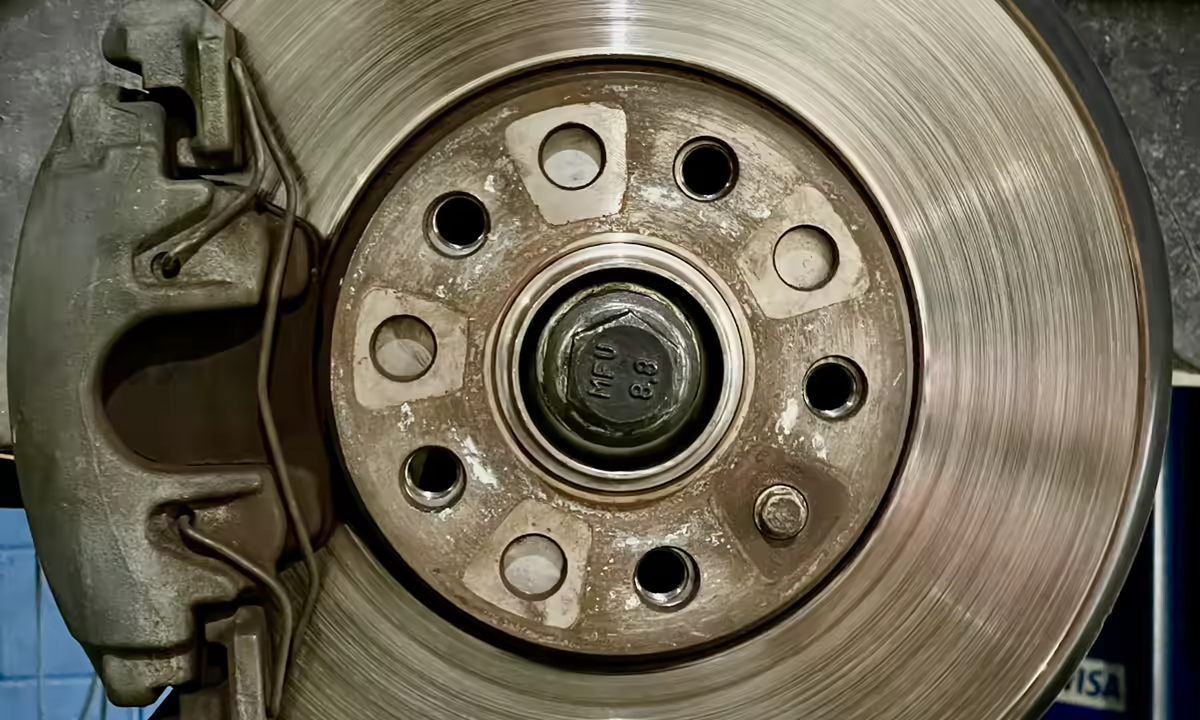
On August 21, the US auto-safety regulator opened an engineering analysis of General Motors' eBoost system and expanded the case to an estimated population of 1,164,820 vehicles. Engineering Analysis EA26006 covers GM models from model years 2023 through 2026, with the Honda Prologue and Acura ZDX included as peer vehicles.¹
The Office of Defects Investigation, or ODI, took that step after it continued to receive reports of lost brake assist. Some describe the assist disappearing immediately during a braking event. That timing diverges from the sequence GM submitted in 2024, in which an internal fracture would leave much of the assist available until the vehicle stopped.¹ ³
This discrepancy is the subject of the new phase. An Engineering Analysis is an open investigation with no defect finding. It is not a recall. The 1,164,820 vehicles make up the estimated population under review.
GM's sequence starts with an internal fracture
The eBoost assembly combines the electronic brake control module with the boost function. In its response to NHTSA, GM described an internal spindle within the mechanism that helps generate pressure. The component is placed under high load as the antilock braking system modulates pressure, and GM identified a spindle fracture during an ABS event as the principal failure mode under review.³
GM linked that fracture risk to reduced material ductility from hydrogen embrittlement, along with irregular finish or high roughness on the spindle threads. The automaker described changes to manufacturing, material tests, and quality control across five spindle “pedigrees.”³ Those findings are GM's account of a particular mechanism. ODI has not adopted it as an explanation for every report in the expanded population.
Under the company's sequence, pressure already built in the system would sustain braking through the ABS event in progress. A GM test beginning at 100 km/h recorded 3.1 additional meters of stopping distance when the spindle fractured. After the vehicle reached a complete stop, boost, ABS, stability control, and traction control would be lost; diagnostic codes would trigger warnings, and vehicle speed would be limited to 70 km/h, or 43 mph.³
GM said the hydraulic path would still allow unassisted operation, which it calls push-through braking, and that the tested vehicles remained within the stopping-distance limits in Federal Motor Vehicle Safety Standard 135.³ The 3.1-meter result and the compliance assessment both come from tests presented by the automaker. The public response does not independently validate later incidents collected by ODI.
Some reports describe no delay
The EA resume records reports that do not follow that sequence: some allege an immediate loss of brake assist instead of a loss only after the vehicle has stopped.¹ A failure during pedal application leaves less time for a driver to recognize the hard pedal and compensate for missing boost. ODI says sudden assist loss may extend stopping distance and increase the risk of a crash or injury.¹
Lost assist does not automatically mean that the entire braking path has disappeared. The system described by GM retains unassisted hydraulic braking. In that state, the driver must supply through the pedal more of the force that the booster previously added. The field reports that prompted the preliminary evaluation in 2024 described a hard brake pedal followed by a “Brake System Failure” message, either at startup or while the 2023 Cadillac Lyriq was moving.²
The Engineering Analysis now has to establish how much pressure and braking response remain when assist disappears without the delay in GM's account. ODI advanced the case from a Preliminary Evaluation so it could assess the safety consequences and determine whether the spindle mechanism fits the broader set of incidents.¹
What the 745 incidents represent
The EA table lists 227 incidents received by ODI and 531 manufacturer records. After removing duplicates received from GM, the agency reports 745 unique incidents.¹ That is a body of reports for analysis, not 745 confirmed diagnoses of a fractured spindle.
The same table places 22 events in the combined “crashes/fires” category: 21 in ODI's column and one from the manufacturer. The resume does not split the total between crashes and fires, and it does not establish that eBoost caused each event. Five injury incidents involved six people. The table lists no fatalities.¹
Reports can reach the agency through different channels and contain allegations that still require technical examination. Deduplication reduces repeated counting of the same incident in data received from the manufacturer; it does not settle the cause. ODI's engineering analysis can compare field evidence, component records, and system behavior before the agency reaches a finding.
Models and model years in the expanded scope
ODI grouped the vehicles equipped with the system by model year:¹
- 2023–2026: Cadillac Lyriq, Chevrolet Colorado, and GMC Canyon;
- 2024–2026: Buick Enclave and Envision; Chevrolet Blazer EV, Equinox EV, and Traverse; Cruise Origin; GMC Acadia;
- 2025–2026: Cadillac Celestiq and Optiq;
- 2024–2026 peer vehicles: Acura ZDX and Honda Prologue.
The Prologue and ZDX are peer vehicles because ODI says they were built by GM through a joint venture with Honda and use the system under analysis.¹ Their inclusion supports comparison across shared components; it does not turn either model into a GM-branded product.
The current scope is far larger than the Preliminary Evaluation opened in April 2024. PE24011 covered 3,322 model-year 2023 Cadillac Lyriqs and began with field reports that GM had verified.² GM had also developed a software diagnostic that cycled the booster to detect a fracture. ODI's initial resume explicitly said that update was not conducted as a recall.²
The investigation still has to resolve the difference
The public record now contains two accounts that the EA must test. GM says the studied spindle fracture preserves pressure through the stop and leaves manual braking within FMVSS 135 limits.³ ODI has collected incidents that allegedly lost assist immediately and says their safety consequences require further analysis.¹ The agency still has to determine whether those reports reflect another behavior of the same component, different operating conditions, or failures unrelated to the spindle.
The NHTSA case and its population apply to the US market. They do not establish coverage, repairs, or an equivalent action for vehicles sold in Brazil. Any later remedy would depend on the outcome of the EA and formal notices applicable to each VIN and market.
Sources
- Engineering Analysis EA26006 — Open Resume · NHTSA, Office of Defects Investigation · https://static.nhtsa.gov/odi/inv/2026/INOA-EA26006-17028.pdf · Aug. 21, 2026
- Preliminary Evaluation PE24011 — Open Resume · NHTSA, Office of Defects Investigation · https://static.nhtsa.gov/odi/inv/2024/INOA-PE24011-11699.pdf · Apr. 11, 2024
Show 1 more sourcesHide sources
- General Motors responses to NHTSA's information request in PE24-011 · General Motors/NHTSA · https://static.nhtsa.gov/odi/inv/2024/INRL-PE24011-14697P1.pdf · June 27, 2024
— Newsroom