Two minutes of darkness, predicted to the second
The Moon's shadow crossed Greenland, Iceland and northern Spain in under two hours on August 12. The longest totality anywhere was 2 minutes 18 seconds. What fits inside a window that short, why the prediction is off by seconds rather than minutes, and why Iceland spent it under cloud.
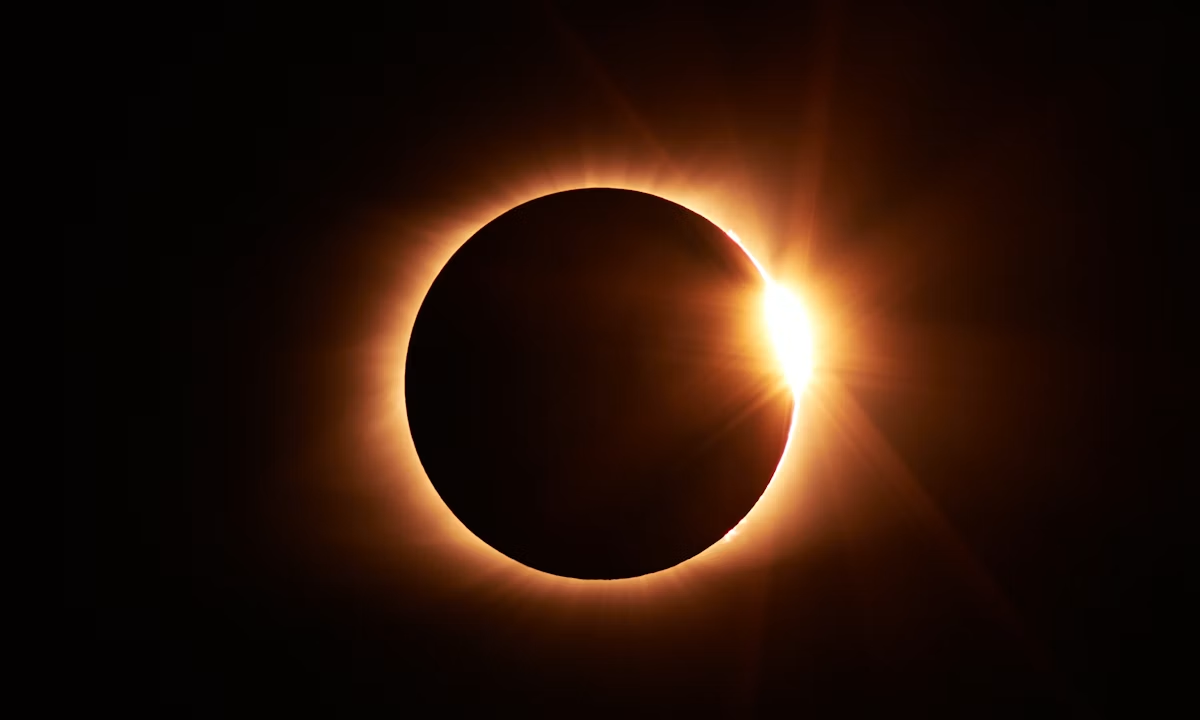
At 8:28 p.m. on August 12, roughly 14,000 people went quiet in León, in northern Spain, as the Sun switched off a few degrees above the horizon.¹² Forty minutes earlier, in Grundarfjörður on Iceland's west coast, another group watched the temperature fall about 6 °C and heard the seabirds stop, with totality itself hidden behind cloud that never opened at the right moment.¹¹
Both groups stood inside the same track, at most 294 km wide, and neither got more than 2 minutes 18 seconds of darkness.¹ The shadow first touched down in far northern Siberia, crossed the Arctic, Greenland, Iceland and the Atlantic, entered Spain through Galicia and left over the Balearics toward the Mediterranean, all in under two hours.² For Spain it was the first total eclipse over the Iberian Peninsula in 114 years, since 1912.⁶
A total eclipse is the most predictable event in astronomy and one of the hardest to actually catch. You can calculate it centuries ahead, it lasts minutes, it lands where it lands, and it still depends on what the weather does over that spot on that afternoon.
Why totality fits in such a narrow strip
The Sun is about 400 times wider than the Moon and sits about 400 times farther away. That coincidence is what makes a total eclipse possible, since the two discs come out nearly the same apparent size, and it is also what makes totality so stingy. The Moon's umbra is a cone that tapers to a point near Earth's orbit. By the time it reaches the ground, its cross-section is a few hundred kilometers across at best.
At the instant of greatest eclipse, 17:45:53 UTC, that cross-section measured 294.0 km, totality ran 2 minutes 18.2 seconds and the Sun stood 25.8° above the horizon.¹ By the end of the track, out over the Mediterranean east of the Balearics, the path had narrowed to 262 km and totality was down to 1 minute 32.8 seconds.¹
That geometry explains the eclipse Spain got. The track crossed 13 autonomous communities,⁶ but with the Sun barely off the horizon: 12° up in Galicia, 2° in Palma de Mallorca. A Coruña had 76 seconds of totality, Burgos 104, León about two minutes.⁵ ¹³ The same shallow angle that carried the shadow to the peninsula also shortened the show and pushed it close to sunset.
A prediction that's off by seconds, not minutes
Where the Moon and Earth will be a thousand years from now is a solved problem. The uncertainty that remains comes from two much less glamorous places: how our planet spins, and what the edge of the Moon looks like.
Fred Espenak's tables for this eclipse were computed with the VSOP87/ELP2000-85 ephemerides and a ΔT of 71.4 seconds.¹ ΔT is the gap between the uniform time that celestial mechanics runs on and the time Earth keeps by rotating. Tidal friction slows the planet by roughly 0.002 seconds per day per century, and on top of that sit decade-scale fluctuations, probably tied to motions in the liquid core, which NASA describes as impossible to predict with current knowledge.³ So the geometry is computed precisely and then converted to clock time using an extrapolation. A one-second error in ΔT doesn't change how long totality lasts, but it slides the track across the map, because at Spanish latitudes the ground runs about 340 meters per second underneath the shadow.
The second limit is that the Moon isn't a smooth ball. Mountains and valleys along its edge shift the instants when the solar disc vanishes and returns, and they are what produce Baily's beads. NASA's own tables warn that they leave out the lunar limb profile, and that including it changes duration by 1 to 3 seconds and moves the edges of the path by 1 to 3 km.¹ With altimetry from Japan's Kaguya probe, completed in 2009 to about ±1 m, and data from the Lunar Reconnaissance Orbiter, those contact times became predictable at the 0.2-second level. The photographic atlas the field leaned on for decades, published by Watts in 1962, carried a random error of 0.2 arcseconds, roughly 400 m on the lunar surface.⁴
"Predicted to the second" is an honest description. "Predicted to a tenth of a second" only holds once someone folds a map of the Moon's edge into the calculation.
What you can still measure in two minutes
The solar corona is hotter than the Sun's surface and millions of times fainter. From the ground it shows up only when the photosphere is covered. "From our unique perspective on Earth during a total solar eclipse, scientists can study the Sun's corona in a way we can't from anywhere else," said Kelly Korreck, NASA's eclipse program manager.⁷ Which is why this much logistics gets built around two minutes of shadow.
The most expensive item in the August campaign was a jet. A NASA WB-57 flew at 50,000 feet, around 740 km/h, along the shadow's path off Iceland's west coast. Chasing the umbra stretched totality to 2 minutes 56 seconds for the crew, against the 2 minutes 18 seconds available to anyone standing still, and put them above the cloud deck that closed over the island.⁷ ⁸ In the aircraft's nose rode SAMI, four cameras assembled by the SCIFLI team at NASA's Langley Research Center, recording the corona at 20 or more frames per second from the visible into the infrared.⁷
The preliminary haul, released two days later by the Southwest Research Institute: more than 2 TB of data, the corona captured in nine wavelengths, and a large, unexpected solar prominence on the eastern limb, glowing pink in hydrogen-alpha.⁸ Principal investigator Amir Caspi had retuned the instrument's exposures after bright coronal features blew out during the North American eclipse of April 2024.⁷ This is raw material: calibration comes first, papers come months later.
Off the Irish coast, an Irish Air Corps Airbus C295 flew at 13,000 feet with an open bubble window and a 500 mm telescope pointed through it. E-CorMag was built by INAF, Italy's astrophysics institute, out of flight spares from two ESA missions, the Proba-3 coronagraph and Solar Orbiter, and photographs the corona at different polarization angles to probe the orientation and large-scale structure of the coronal magnetic field.⁹ The aircraft went out over the Atlantic to meet the shadow, sitting above most of the weather and buying a little extra time inside the umbra.
The Sun isn't the only thing an eclipse measures. In Iceland, two teams launched 80 weather balloons across 26 hours, from 18 hours before totality to 8 hours after, to find out whether a sudden blackout collapses the atmospheric boundary layer in a place where the August Sun barely sets. In Spain, three more teams flew six balloons carrying 360-degree cameras and ozone sensors.⁷
ESA manufactures eclipses now, and still chased this one
While Europe waited on the Moon, two ESA satellites were doing the same job on their own schedule. Proba-3 flies in formation with 150 meters between the two craft, held to millimetre precision: one carries a 1.4 m disc that casts an 8 cm shadow across the coronagraph aperture on the other. The orbit takes 19.6 hours, and the artificial eclipse can be held for up to six hours at a stretch.¹⁰
On the morning of August 12, the pair produced its 65th artificial eclipse and imaged the inner corona a few hours before observers on the ground saw the real thing. Shortly afterwards the Moon drifted through the instrument's field of view, giving ESA a double eclipse.¹⁰
If you can manufacture six hours of totality per orbit, why chase two minutes? Because the two answer different questions. Andrei Zhukov of the Royal Observatory of Belgium, principal investigator for ASPIICS, used an artificial eclipse image taken two weeks earlier to predict how the corona would look on the 12th. Jorge Amaya, who coordinates space-weather modeling at ESA, puts the natural eclipse's job plainly: it lets them check whether the models are right by comparing forecast against observation.¹⁰ And no satellite can do what the Moon did that afternoon, switching off the Sun over an entire slice of Earth's atmosphere while balloons, radio telescopes and people underneath measure the response.
What eclipses have already delivered
Two of the most cited results in modern physics came out of windows exactly this short. On August 18, 1868, watching a total eclipse from India, Pierre Janssen found a yellow line in the spectrum that matched no element known on Earth. Norman Lockyer reached the same line weeks later. It was helium, and nobody isolated it in a terrestrial laboratory for another 27 years.¹⁵
On May 29, 1919, two British expeditions photographed stars around the eclipsed Sun to measure whether gravity bends light. One went to the island of Príncipe, off West Africa; the other to Sobral, in Ceará, Brazil, on the recommendation of Henrique Morize, then director of the Observatório Nacional. The glass plates from the 4-inch telescope set up at Sobral produced the campaign's strongest measurements, and the result announced in London on November 6 favored general relativity over the Newtonian prediction.¹⁶ The Observatório Nacional still keeps the gallery of those plates.¹⁶
What it looked like from the ground
Iceland lost. Grundarfjörður woke up overcast, it rained, and a gap in the cloud passed in front of the Sun a few minutes before totality, enough for the partial phase and not for the corona. What was left was everything else: a darkness deeper than any Icelandic night in August, harbor lights coming on mid-afternoon, a 360-degree sunset along the clearest stretch of horizon to the north, wind picking up.¹¹ Caspi was blunt afterwards about why the science flew at 50,000 feet in the first place: the track ran almost entirely over the Atlantic, where cloud is common.⁸
Spain did better, with exceptions. Galicia and Asturias were partly or fully clouded over. León got clear skies, and NASA photographer Bill Ingalls shot a sequence from San Millán de los Caballeros in which the prominence shows up as a loop of plasma beside the covered disc.¹³ In Palma, totality arrived with the Sun nearly in the sea. Barcelona, just outside the track, reached 99.8% coverage.¹²
Traffic behaved as forecast. Spain's DGT expected between 400,000 and 1.5 million extra trips into the totality zone,⁶ the security deployment ran to about 34,000 officers, and the roads back to Madrid and Barcelona jammed around 10 p.m.¹² One Iberia flight stretched totality to 2 minutes 7 seconds at 3,000 meters, a budget version of the WB-57 trick.¹² The day before, science minister Diana Morant had summed up what the government wanted from the event: "Mañana España volverá a mirar al cielo para vivir un momento histórico."⁶
And from Brazil
Nothing. Two days ahead, the Observatório Nacional published the plain notice that the shadow was headed entirely for the northern hemisphere and that Brazil would not even catch the partial phase, leaving the live stream as the local option.¹⁴ Astronomer Josina Oliveira do Nascimento laid out the geometry that decides it: inside the umbra you see a total eclipse, inside the penumbra a partial one, outside both, nothing.¹⁴
Brazil's next solar eclipse is the annular of February 6, 2027, on Carnival Saturday, partial across most of the country with the ring confined to a narrow band in the south. The next total one waits until August 12, 2045, when the track crosses states in the north and northeast.¹⁴ By calendar coincidence, another August 12.
Verdict
The August 12 eclipse had been on the books for decades: the width of the track, the clock time in every town, the duration to a tenth of a second for anyone who folded in the lunar limb data. None of that settled what any given person saw. Iceland, the land closest to where totality ran longest, got the cloud. León, with the Sun almost on the horizon, got clear sky and a prominence nobody had ordered. The arithmetic tells you where to stand. The rest is still luck, which is exactly why a jet, a C295 and 86 balloons went up to avoid depending on it.
Sources
- Fred Espenak, NASA/GSFC. "Total Solar Eclipse of 2026 Aug 12," path table: https://eclipse.gsfc.nasa.gov/SEpath/SEpath2001/SE2026Aug12Tpath.html (greatest eclipse 17:45:53.8 UT, 294.0 km path, 2m18.2s, Sun at 25.8°, ΔT = 71.4 s, VSOP87/ELP2000-85 ephemerides). Lunar limb caveat (1 to 3 seconds of duration, 1 to 3 km on the limits): https://eclipse.gsfc.nasa.gov/SEgoogle/SEgoogle2001/SE2026Aug12Tgoogle.html
- NASA Science. "Total Solar Eclipse on August 12, 2026," https://science.nasa.gov/eclipses/future-eclipses/total-solar-eclipse-on-august-12-2026/ (countries in the path; totality at 5:48 p.m. local in Reykjavík and 8:28 p.m. local in León).
Show 14 more sourcesHide sources
- NASA/GSFC. "Delta T (ΔT) and Universal Time," https://eclipse.gsfc.nasa.gov/SEhelp/deltaT.html
- NASA/GSFC. "The Lunar Limb Profile and Eclipse Predictions," https://eclipse.gsfc.nasa.gov/SEhelp/limb.html — Xavier Jubier, "Lunar Limb Profiles at Total Solar Eclipses," DPS 2017, https://sites.williams.edu/eclipse/files/2020/10/ecl17-DPS-Provo-Bailysbeads-417.17-Jubier.pdf (Kaguya at ±1 m, Watts 1962 at 0.2 arcseconds, contact predictions at the 0.2-second level).
- Instituto Geográfico Nacional (Spain). "El eclipse total del 12 de agosto de 2026," https://eclipses.ign.es/eclipse-total-sol-de-12-de-agosto-2026.html (times and durations by municipality; 76 s in A Coruña, 104 s in Burgos).
- Ministerio de Ciencia, Innovación y Universidades. "España volverá a vivir mañana un eclipse total de Sol en la Península Ibérica, 114 años después," Aug 11, 2026, https://www.ciencia.gob.es/Noticias/2026/agosto/manana-eclipse-total-sol-Peninsula-Iberica.html (1912; 13 autonomous communities; DGT forecast of 400,000 to 1.5 million trips; Diana Morant quote).
- Vanessa Thomas, NASA Goddard. "NASA Science Soars During August Total Solar Eclipse," Jul 27, 2026, https://science.nasa.gov/science-research/heliophysics/nasa-science-soars-during-august-total-solar-eclipse/ (WB-57 at 50,000 ft; SAMI/SCIFLI; balloon campaigns in Iceland and Spain; quotes from Kelly Korreck, Amir Caspi, Angela Des Jardins and Matthew Bernards).
- Southwest Research Institute, via Phys.org. "Airborne observatory improves views of solar corona during cloud-covered eclipse," Aug 14, 2026, https://phys.org/news/2026-08-airborne-observatory-views-solar-corona.html (2m56s of totality, more than 2 TB, nine wavelengths, prominence on the eastern limb).
- Trinity College Dublin. "Scientists take to the skies to observe 2026 Solar Eclipse from Flying Observatory," Aug 10, 2026, https://www.tcd.ie/news_events/top-stories/featured/eclipse-2026/ — instrument design: "Optical design and calibration of E-CorMag," SPIE 13699, https://www.spiedigitallibrary.org/conference-proceedings-of-spie/13699/3075164/Optical-design-and-calibration-of-E-CorMag-a-telescope-for/10.1117/12.3075164.full
- ESA. "How ESA mimics and models the 2026 total solar eclipse," Aug 10, 2026, https://www.esa.int/Enabling_Support/Space_Engineering_Technology/How_ESA_mimics_and_models_the_2026_total_solar_eclipse — "Proba-3's eclipse hours before totality in Europe," Aug 14, 2026, https://www.esa.int/ESA_Multimedia/Images/2026/08/Proba-3_s_eclipse_hours_before_totality_in_Europe — "Proba-3's first artificial solar eclipse," Jun 16, 2025, https://www.esa.int/Enabling_Support/Space_Engineering_Technology/Proba-3_s_first_artificial_solar_eclipse
- Alison Klesman, Astronomy. "Total solar eclipse 2026: As it happened from Iceland and Spain," Aug 12, 2026, https://www.astronomy.com/observing/total-solar-eclipse-2026-live-updates-from-iceland-and-spain/
- Telecinco. "De las nubes en Asturias a la puesta de sol en las playas baleares: así ha sido el histórico eclipse," Aug 12, 2026, https://www.telecinco.es/noticias/ciencia-y-tecnologia/20260812/ultima-hora-historico-eclipse-sol-espana-mejor-escenario_19_019933325.html
- NASA Earth Observatory. "A Sunflower's View of Totality," Aug 14, 2026, https://science.nasa.gov/earth/earth-observatory/a-sunflowers-view-of-totality/
- Observatório Nacional (MCTI, Brazil). "Eclipse solar de 12 de agosto não será visível no Brasil," Aug 10, 2026, https://www.gov.br/observatorio/pt-br/assuntos/noticias/eclipse-solar-de-12-de-agosto-nao-sera-visivel-no-brasil-observatorio-nacional-fara-retransmissao-ao-vivo-1
- Astronomy. "Aug. 18, 1868: Helium is discovered," https://www.astronomy.com/today-in-the-history-of-astronomy/aug-18-1868-helium-is-discovered/
- Luís C. B. Crispino and Marcelo Lima. "Shadow of the Moon and general relativity: Einstein, Dyson, Eddington and the 1919 light deflection," Revista Brasileira de Ensino de Física, https://www.scielo.br/j/rbef/a/tsCDFzLWszcgV8XzMN9KvQH/?lang=en — Sobral plate gallery, Observatório Nacional, https://daed.on.br/sobral/index.php?lang=en-us
— Newsroom