Surgical robots now train inside virtual bodies
NVIDIA open-sourced a GPU simulator for catheters, anatomy and fluoroscopy, capable of running 8,192 environments in parallel. Simulation fills a gap no one can close with real-world data: rare failures. Convincing a regulator that the robot can safely touch a patient is another challenge entirely.
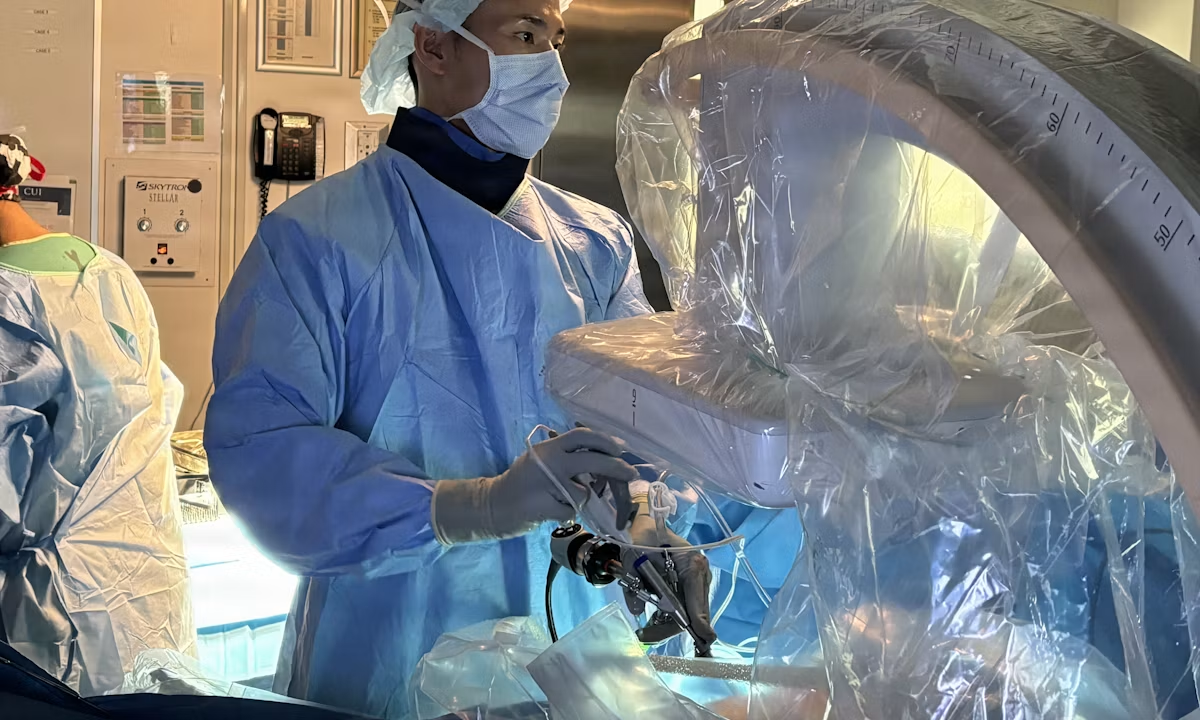
On July 22, NVIDIA pushed Medical Physics Simulation to GitHub, a new piece of its Isaac for Healthcare platform.¹ The simulator runs entirely on the GPU and does three things: it drives catheters and guidewires through a vascular tree reconstructed from a CT scan, renders the fluoroscopy a physician would see in that scene, and, in the generative module, produces surgical video conditioned on how the instrument moves.¹ ² ³ NVIDIA led with a performance claim: 8,192 training environments in parallel cut policy training from over five hours to under two minutes.¹
The named partners include CMR Surgical (with Cambridge Consultants), Johnson & Johnson MedTech, Medtronic Structural Heart, XCath and Inner Logic.¹
The implied promise is seductive. If you can generate situations on a computer that almost never arise in an operating room, you can train a robot to handle them before a patient is involved. What doesn't come in the box is the question that follows, the one that decides whether the robot ever reaches a patient: how much of that training a regulator will accept as evidence.
What was actually released
Three pieces, open to different degrees.
The first is the endoluminal solver. Catheters and guidewires are modelled as Cosserat rods (elastic rods that bend, twist and stretch) and solved with XPBD, a family of position-based methods that trades physical exactness for stability and speed.² ³ The solver runs in batches on the GPU, with the wire constrained inside the vessel mesh.² ⁴
The second is the fluoroscopy renderer, written in Slang: digitally reconstructed radiographs with the catheter's attenuation composited in the same pass, a digital subtraction angiography pipeline, Poisson noise, Compton scatter and detector blur.⁴ This is the synthetic X-ray the policy sees, standing in for the C-arm.
The third is Cosmos-H-Dreams, and it's a different animal. Instead of solving equations, it runs a generative world model, derived from Cosmos-H-Surgical-Simulator, that takes a first frame and a live stream of action vectors and predicts the surgical video that follows, in real time, served over WebRTC to a browser or a Meta Quest.⁵ ⁶
The licensing deserves a line, because the release has two layers: the code ships under Apache-2.0, the model weights under the NVIDIA Open Model License, which is NVIDIA's own.⁵ ⁶ The hardware bar is familiar, too: an NVIDIA GPU with compute capability 7.0 or higher, 8 GB of VRAM for interactive single-environment use, Ubuntu and CUDA 12.8. The repo lists its tested configuration as a 48 GB RTX A6000.⁴
The "first" in NVIDIA's headline¹ also deserves some context. SOFA, the medical simulation framework Inria has maintained under LGPL since the mid-2000s, was already running nonlinear finite-element soft tissue on a GPU in work published in 2008.¹⁷ ¹⁸ Simulating tissue on a graphics card is not new. What is new is the number of parallel environments wired into a reinforcement-learning pipeline, plus the fact that the generative piece ships alongside it.
The rare failure is the data nobody has
The underlying argument for all of this is honest, and the consortium that assembled the largest open medical-robotics dataset states it without hedging: existing datasets "are small, single-embodiment, and rarely shared openly."⁷
Then there is the shape in which failure data arrives. The classic tally of what goes wrong in robotic surgery came out of MAUDE, the FDA's adverse-event database: between 2000 and 2013 there were 10,624 reports, of which 8,061 were device malfunctions (75.9%), 1,391 were patient injuries (13.1%) and 144 were deaths (1.4%).⁸ They sketch the long tail that clinical training data rarely captures. And they arrive as retrospective paperwork, not as the synchronized video and kinematics that training actually needs.
Nobody schedules a vessel perforation to collect data. That is where simulation has a strong and legitimate case.
The number NVIDIA chose to show
That five-hours-to-two-minutes figure is a vendor benchmark. The announcement doesn't say what task the policy was trained to perform, on which GPU, or what baseline the five hours were measured against.¹ And the company publishing the number sells the card that produces it.
NVIDIA's technical blog is more useful precisely because it is more modest: roughly 1,300 Hz for single-environment physics, 60 Hz for physics across 512 environments, and 63 frames per second for the complete simulation and rendering loop, all for catheter navigation.² Still an in-house measurement, but at least it says which task it's measuring.
The caveat applies to both sets of figures. Speed measures how fast you can manufacture experience. It says nothing about whether that experience matches a real body.
Where the virtual body stops
The technical name for the difference is sim-to-real, and published results describe it with a clarity the marketing material lacks.
The most recent numbers come from the Open-H consortium's own paper, which NVIDIA is part of. GR00T-H, the foundation model trained on that dataset, was the only model evaluated that completed a structured suturing benchmark end to end, in 25% of trials against 0% for everything else, and averaged 64% success across a 29-step ex vivo suturing sequence.⁷ Those are good numbers for a young field of research, and a long way from what anyone expects of a surgical instrument.
One of the clearest recent autonomy results, SRT-H (Johns Hopkins, Science Robotics, July 2025), performed the clipping and cutting phase of a cholecystectomy with no human intervention on 8 of 8 ex vivo pig gallbladders, after roughly 18,000 demonstrations collected on more than 30 gallbladders.⁹ ¹⁰ It's impressive, and it's narrow: one phase, of one procedure, on tissue outside a living body. Work by Long and colleagues, also in Science Robotics, pushed further in the direction that matters, taking policies straight from simulation to the real robot, running five assistive tasks on ex vivo tissue and validating three tasks in a live animal.¹¹ That is a measure of how narrow the evidence remains.
Then there is the bias baked into synthetic data. A world model learns whatever anatomy it was shown, and the Cosmos-H-Surgical-Simulator training mixture is documented: half the training budget goes to CMR Versius data covering four procedures (cholecystectomy, hysterectomy, inguinal hernia and prostatectomy, around 17 million frames), and the other half is split across eight platforms, some represented only marginally. Moon Surgical contributes about 12,000 frames, 0.1% of the mix.⁶ A good chunk of the rest is bench work: peg transfer, needle handover, knot tying.⁶ Generating "rare scenarios at scale" with a model whose experience is dominated by four common procedures on one vendor's robot is exactly the kind of claim that has to be tested, not assumed.
Classical physics has its own limit, and it lives in the parameters. In issue #237 on the repo, a developer who builds catheter models points out that the solver takes a single Young's modulus for the entire rod and derives torsion from it, whereas a real catheter has a floppy distal tip, a stiffer proximal shaft and a braided construction designed specifically to decouple torque from bending.¹⁹ The request is small (per-segment stiffness), and what it exposes is large: fidelity in this field lives in details of exactly that size.
What counts as evidence to a regulator
The FDA already has a route for simulation evidence, and it predates the current wave: the final guidance of November 16, 2023, aligned with the ASME V&V 40-2018 standard.¹³ ¹⁴ The core idea is that credibility is not a property of the software. It is an argument built for a specific context of use, scaled to how much weight the model's answer carries in the decision, and backed by verification, validation and uncertainty quantification.¹³ ¹⁴
Translated to this case: "we trained in 8,192 virtual bodies" is not evidence of anything on its own. "This model, for this question, validated against this bench and animal data, with this much uncertainty" can be.
The agency's actual clearance record is more restrained. A systematic review in npj Digital Medicine mapped 49 FDA-cleared surgical robots between 2015 and 2023: 42 (86%) at autonomy level 1, the surgeon-assistance tier; 4 at level 2; 3 at level 3; none at levels 4 or 5.¹⁵ Forty-four came through 510(k), five through De Novo, none through PMA, and only 2 had machine-learning capability recognized by the agency.¹⁵ The autonomy scale is the one Yang and colleagues proposed in 2017, running from 0 (none) to 5 (full).¹⁶
That review covers products cleared through 2023, not the prototypes reported in 2025 and 2026. Even so, it marks the distance: research can now perform narrow tasks without intervention, while the review found no products at levels 4 or 5. It is the same boundary that showed up in the blood-pressure smartwatch fight, with the roles reversed: there, an estimate was being sold as a measurement; here, the temptation is to sell training as validation.
What shows up in the repo
The medical-device trade press covered the release. Outside it, things were quiet: the Hacker News submission sat at 4 points with no comments.²¹
What can be observed concretely is the ordinary friction of a young stack. Alongside the stiffness request, an open issue reports that the robotic ultrasound pipeline breaks because of a Warp API mismatch; the reporter tried three versions of the library without success.²⁰ These are people trying to get the simulator running on their own machines, which already says something good: the code really did ship.
The partners' tone is what you would expect from interested parties. Chris Fryer, CTO of CMR Surgical, says that "open source models allow us to build on shared knowledge, accelerating responsible innovation."¹ CMR contributed nearly 500 hours of anonymized clinical data from its Versius system to the open dataset.¹
In Brazil, prostatectomy entered coverage
Meanwhile, one application of robotic surgery in Brazil crossed the line that matters to budgets. In September 2025, Portaria SCTIE/MS nº 72 incorporated robot-assisted radical prostatectomy into the public health system, following a favourable recommendation from Conitec, the country's health technology assessment body.²² The private-insurance regulator, ANS, then added the same procedure to its mandatory coverage list, making it the first robotic surgery that private plans are required to cover.²³
The recommendation rested on clinical outcomes and economic analysis, comparing the robotic technique with open and laparoscopic techniques.²² The training benchmark discussed here did not open that door. When a virtual-environment number turns up in a sales deck, that is the calculation it does not replace.
Verdict
What NVIDIA released is real and solves a real problem. Until now, every group rewrote its own catheter solver, its own synthetic fluoroscopy and its own data format; a shared stack, with Apache-2.0 code and common datasets, removes that tax and makes currently incomparable work comparable. The lineage did not start last month either: ORBIT-Surgical showed back in 2024 that you could train surgical tasks in Isaac Sim and transfer them to a physical dVRK.¹²
What it doesn't do is shorten the clinical path. Simulation moves the bottleneck rather than removing it: it shifts from collecting data to proving that the simulated data answers the question being asked. The FDA has already written down how it wants to hear that argument, and it is specific, laborious and expensive.
What is left is an asymmetry. Failing a million times inside a body that doesn't exist is cheap learning, and industrializing it was a sound engineering decision. But the proof that the robot works still comes from tissue, from animals and from patients, and no GPU makes that queue move faster.
Sources
- NVIDIA Open Sources First GPU-Accelerated Medical Physics Simulation Framework · NVIDIA Blog · https://blogs.nvidia.com/blog/medical-physics-simulation-open-source/ · 2026-07-22.
- Developing Healthcare Robotics with GPU-Native Medical Physics Simulation · NVIDIA Technical Blog · https://developer.nvidia.com/blog/developing-healthcare-robotics-with-gpu-native-medical-physics-simulation/ · accessed 2026-08-17.
Show 21 more sourcesHide sources
- Medical Physics Simulation (official documentation) · NVIDIA Isaac for Healthcare · https://isaac-for-healthcare.github.io/medical-physics-simulation/ · accessed 2026-08-17.
- i4h-workflows, Catheter Navigation workflow: components, solvers and hardware requirements · GitHub · https://github.com/isaac-for-healthcare/i4h-workflows · accessed 2026-08-17.
- Cosmos-H-Dreams (README and LICENSE: Apache-2.0 code, NVIDIA Open Model License weights) · GitHub · https://github.com/isaac-for-healthcare/Cosmos-H-Dreams · accessed 2026-08-17.
- Cosmos-H-Surgical-Simulator (README: supported embodiments and Open-H training mixture) · GitHub · https://github.com/NVIDIA-Medtech/Cosmos-H-Surgical-Simulator · accessed 2026-08-17.
- Open-H-Embodiment: A Large-Scale Dataset for Enabling Foundation Models in Medical Robotics · arXiv:2604.21017 · https://arxiv.org/abs/2604.21017 · 2026-04-22.
- Alemzadeh, H. et al. Adverse Events in Robotic Surgery: A Retrospective Study of 14 Years of FDA Data · PLOS ONE · https://journals.plos.org/plosone/article?id=10.1371/journal.pone.0151470 · 2016 · PMID: 27097160 · DOI: 10.1371/journal.pone.0151470.
- SRT-H: A hierarchical framework for autonomous surgery via language-conditioned imitation learning · Science Robotics · https://www.science.org/doi/10.1126/scirobotics.adt5254 · 2025-07-09 · PMID: 40632876 · DOI: 10.1126/scirobotics.adt5254.
- SRT-H (project page: 8 ex vivo gallbladders, ~18,000 demonstrations) · Johns Hopkins · https://h-surgical-robot-transformer.github.io/ · accessed 2026-08-17.
- Long, Y. et al. Surgical embodied intelligence for generalized task autonomy in laparoscopic robot-assisted surgery · Science Robotics · https://www.science.org/doi/10.1126/scirobotics.adt3093 · 2025 · PMID: 40668896 · DOI: 10.1126/scirobotics.adt3093.
- ORBIT-Surgical: An Open-Simulation Framework for Learning Surgical Augmented Dexterity · ICRA 2024 · https://arxiv.org/abs/2404.16027 · 2024.
- Assessing the Credibility of Computational Modeling and Simulation in Medical Device Submissions (final guidance) · U.S. FDA · https://www.fda.gov/regulatory-information/search-fda-guidance-documents/assessing-credibility-computational-modeling-and-simulation-medical-device-submissions · 2023-11-16.
- ASME V&V 40-2018: Assessing Credibility of Computational Modeling through Verification and Validation: Application to Medical Devices · ASME · https://www.asme.org/codes-standards/find-codes-standards/assessing-credibility-of-computational-modeling-through-verification-and-validation-application-to-medical-devices · 2018.
- Lee, A. et al. Levels of autonomy in FDA-cleared surgical robots: a systematic review · npj Digital Medicine · https://pmc.ncbi.nlm.nih.gov/articles/PMC11053143/ · 2024-04-26 · DOI: 10.1038/s41746-024-01102-y.
- Yang, G.-Z. et al. Medical robotics — Regulatory, ethical, and legal considerations for increasing levels of autonomy · Science Robotics · https://www.science.org/doi/10.1126/scirobotics.aam8638 · 2017-03-15 · DOI: 10.1126/scirobotics.aam8638.
- Comas, O. et al. Efficient nonlinear FEM for soft tissue modelling and its GPU implementation within the open source framework SOFA · ISBMS 2008 · https://inria.hal.science/hal-00841568 · 2008.
- About SOFA (framework, licence and history) · SOFA Framework / Inria · https://www.sofa-framework.org/about/ · accessed 2026-08-17.
- Per-segment rod stiffness in RodConfig.material (catheter navigation), issue #237 · GitHub · https://github.com/isaac-for-healthcare/i4h-workflows/issues/237 · 2026-07-23.
- Robotic ultrasound sim fails on Warp API mismatch in sim_with_dds.py, issue #232 · GitHub · https://github.com/isaac-for-healthcare/i4h-workflows/issues/232 · 2026-07-07.
- Hacker News submission of the announcement (4 points, no comments) · Hacker News · https://news.ycombinator.com/item?id=49049622 · accessed 2026-08-17.
- Relatório final nº 1030, Prostatectomia radical assistida por robô (Portaria SCTIE/MS nº 72, 2025-09-30) · Conitec / Brazilian Ministry of Health · https://www.gov.br/conitec/pt-br/midias/relatorios/2025/relatorio-final-1030-prostatectomia-robotica-72 · 2025.
- ANS inclui 1ª cirurgia robótica na cobertura obrigatória dos planos de saúde · Agência Nacional de Saúde Suplementar · https://www.gov.br/ans/pt-br/assuntos/noticias/beneficiario/ans-inclui-1o-cirurgia-robotica-na-cobertura-obrigatoria-dos-planos-de-saude · accessed 2026-08-17.